
The evening shift closes knowing several things. A supplier delivery arrived short. The second fryer has been cutting out intermittently. A guest who had a problem with their table was promised a call from the manager. Two prep containers were filled early for the next day, and two were not.
None of this is written down. The people who know it are tired, and the people who need the information have not arrived yet. The next morning, the kitchen discovers the shortage when an item runs out, the fryer when it fails during service, and the guest issue when the guest calls again. Nothing was deliberately hidden. The information simply did not travel between shifts.
For restaurants, standardized restaurant shift handover procedures help prevent this gap between what one team knows and what the next team needs to do. They establish what must be communicated, where it is recorded, who acknowledges it, and how unresolved issues are followed up. Without these procedures, service consistency depends too heavily on individual memory rather than a reliable operating system.
Why Restaurant Shift Handovers Fail at the Worst Moment
Shift handover takes place at one of the most difficult points in the working day. The outgoing team is finishing tasks, clearing stations, and counting stock, with the end of a long shift in sight. The incoming team is setting up and checking its own stations. The overlap is short, and both teams are busy.
Whatever gets passed on is therefore communicated quickly, verbally, and often in whatever order it comes to mind. Without a defined restaurant shift handover checklist, the information that survives depends on who was on duty and what they happen to remember.
An experienced supervisor may remember to mention the faulty fryer, while a newer supervisor reports the supplier shortage because it was the last thing that happened. Neither is necessarily careless. The problem is that, without an agreed list of required information, the handover reflects recent memory rather than operational importance.
The consequences appear later and somewhere else. The incoming shift rediscovers each issue when it becomes a problem, often during service and sometimes in front of a guest. Management sees a complaint, a shortage, and an equipment breakdown as separate incidents, when all three may have originated from the same failed transition between shifts.
What Restaurant Shift Handover Procedures Must Cover
The solution is not a longer message in the team group chat. Effective restaurant handover procedures need to establish four things that every outgoing and incoming shift can follow consistently.
1. Define what information must be handed over. Establish standard categories such as stock shortages, equipment faults, guest complaints, pending callbacks, preparation status, outstanding cleaning tasks, and supplier issues. Each category should be addressed every time, even when there is nothing to report, so the incoming team can distinguish between a confirmed all-clear and information that was never checked.
2. Standardize the format and location. The handover should use consistent headings and a designated location, whether that is an existing digital tool, a tablet, or a paper log. Incoming staff should be able to review the information before service begins, rather than asking colleagues for updates while guests are waiting.
3. Establish acknowledgment and ownership. Recording an issue does not automatically transfer responsibility. The incoming supervisor should confirm receipt, understand what requires action, and know who is accountable for each outstanding item. A clear sign-off turns a message into a transfer of operational responsibility.
4. Create an escalation process for unresolved issues. Some problems cannot be resolved within a single shift. Equipment faults, recurring stock discrepancies, and unresolved guest complaints need a named owner, an appropriate deadline, and a defined escalation path. Otherwise, the same issues are copied from one handover to the next without anyone taking responsibility for resolution.
These four elements form the foundation of a practical restaurant shift handover checklist. They make the process repeatable without turning it into unnecessary administration.
A Restaurant Shift Handover Checklist Should Be Short Enough to Use
Many shift handover documents fail because they are too long rather than too short. A report describes the shift that ended, while a handover carries only the information the next shift must act on or be aware of. When these two purposes are confused, the document becomes a record that nobody reads, and the team quietly returns to verbal communication.
A workable handover format can fit on one page or one screen. It should use the same headings every time, be completed during the shift rather than reconstructed at closing, and make outstanding actions easy to identify. The objective is not to document everything that happened, but to ensure that important information reaches the people responsible for acting on it.
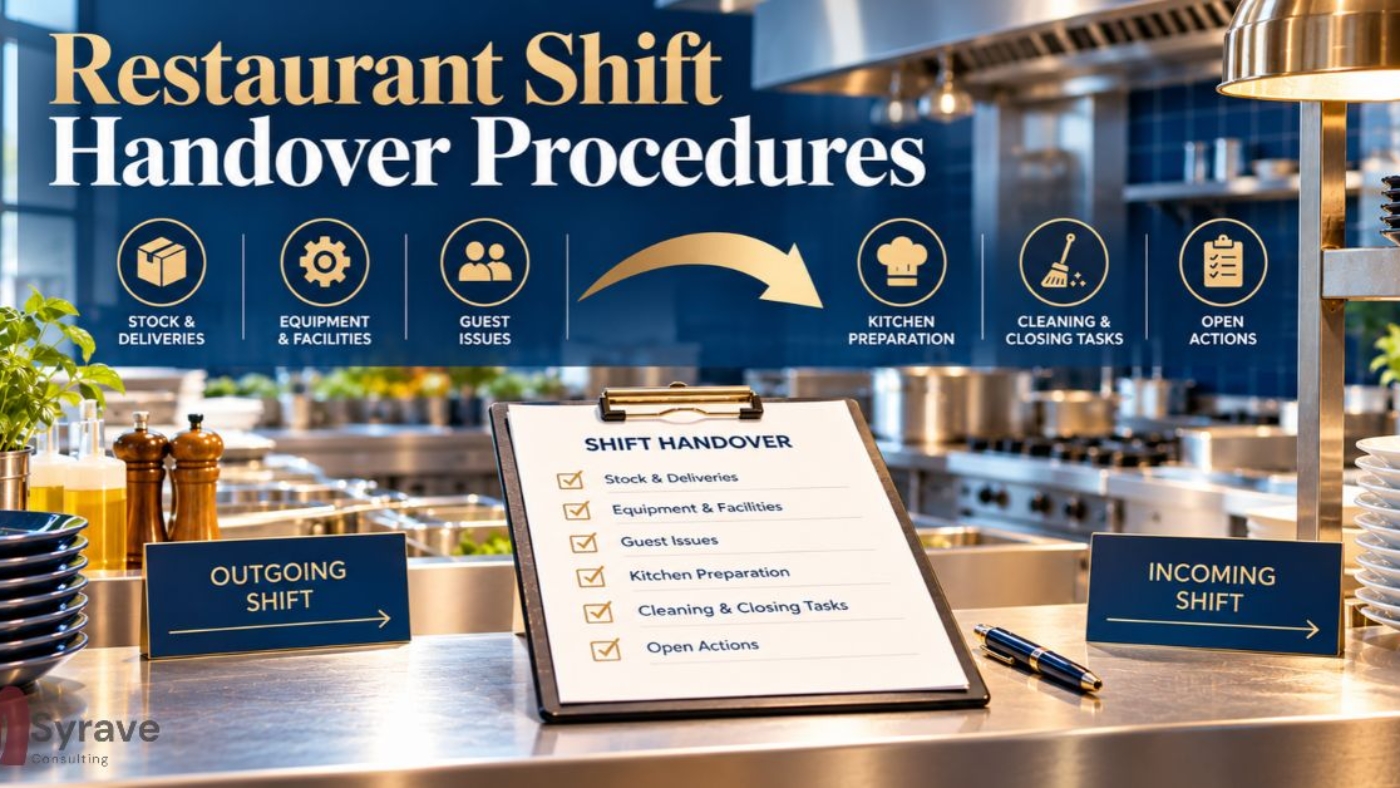
A practical checklist might include the following categories:
- Stock and deliveries: Short deliveries, unavailable ingredients, pending orders, and items requiring follow-up.
- Equipment and facilities: Faults, temporary workarounds, maintenance requests, and safety concerns requiring attention.
- Guest issues: Complaints, promised callbacks, service recovery commitments, and unresolved requests.
- Kitchen preparation: Prep completed, prep outstanding, items requiring replenishment, and any relevant food safety or storage checks.
- Cleaning and closing tasks: Outstanding cleaning, sanitation, waste handling, and station readiness requirements.
- Open actions: The issue, its owner, the next action, the deadline, and the escalation contact where applicable.
The exact categories will vary by restaurant concept and operating model. A quick-service restaurant, a full-service dining venue, and a multi-outlet F&B group may have different handover requirements, but all need a consistent way to identify outstanding work and transfer responsibility.
The sign-off is especially important. It confirms that the incoming shift has received the information and knows what remains to be done. Without that acknowledgment, a handover is a broadcast rather than a completed transfer of responsibility.
Standardized Shift Handovers Support Consistency Across Restaurant Outlets
For a single restaurant, a missed handover can disrupt service for the following shift. For a restaurant group, inconsistent handover practices create a wider operational challenge because each outlet may develop its own way of communicating, recording, and escalating problems.
One manager may maintain a detailed log, another may rely on a messaging group, and a third may pass information verbally. Each approach may appear workable in isolation, but the differences make it harder for head office to establish common operating standards, identify recurring issues, and compare performance across locations.
Standardizing restaurant shift handover procedures creates a common baseline while allowing for differences in each outlet’s operating requirements. Every location follows the same core rules for recording issues, assigning responsibility, acknowledging receipt, and escalating unresolved items.
This also improves operational visibility. When recurring equipment faults, stock shortages, or guest complaints are recorded consistently, managers can distinguish isolated incidents from patterns that require a broader response. Instead of repeatedly resolving the same symptoms, the business can investigate the underlying causes and improve its standard operating procedures.
For growing F&B businesses, this is an important part of building operational infrastructure that supports expansion. Consistent service should not depend on whether a particular supervisor happens to be working that day.
How Syrave Approaches Restaurant SOP Standardization
At Syrave Consulting, we design and document the operational procedures that help F&B teams deliver consistent service. Our work focuses on building practical systems alongside the people responsible for running them, rather than delivering recommendations and leaving implementation to the client.
For shift handovers, this means defining the required information, designing a format that teams can use at the end of a demanding shift, establishing sign-off and accountability rules, and creating an escalation process for unresolved issues. The result is a documented handover procedure that managers can implement, review, and maintain across outlets.
We are vendor-neutral on technology. The handover can live in the messaging tool, tablet, or paper log that the business already uses. New software is not necessarily the answer when the real gap is what gets communicated, who owns the next action, and how completion is confirmed.
Our engagements follow four stages: Mobilization, Discovery, Design and Documentation, and Implementation and Optimization. The final stage matters because a procedure that looks clear on paper has not yet demonstrated that it works under real trading conditions. We work with the team to refine the process based on how it performs during actual operations.
This approach supports the head chefs, restaurant managers, and shift supervisors who already understand where handovers tend to fail. They know which details cause problems when they go missing. What they often need is an agreed set of requirements, a format short enough to use consistently, and the authority to require acknowledgment and follow-through. That is the operational gap we help close.
Start by Reviewing Your Last Three Service Problems
Take the three most recent service problems at your busiest outlet and ask one question about each: Did somebody on the previous shift already know about it?
For many restaurant operations, the answer will be yes more often than expected. A shortage may have been noticed before closing, a guest may already have been promised a callback, or a piece of equipment may have shown signs of failure earlier in the day. The information existed, but the handover process did not reliably carry it forward.
That is the case for designing restaurant shift handover procedures rather than simply asking people to communicate better. A defined process gives every shift the same expectations, makes responsibility visible, and helps prevent known issues from becoming avoidable service failures.
Syrave Consulting offers a complimentary 60-minute Discovery Call to review what currently travels between your shifts and what does not. We will examine your existing approach, identify gaps in how information and responsibility are transferred, and provide practical feedback on where your operating procedures may need attention.
No pitches, no commitments. Just a direct review of your current process and an honest discussion of what is missing.
Connect with Syrave – Business Operations Consulting
Email: ngan.nth@syrave.vn
Book a meeting at here: discovery conversation
LinkedIn: linkedin.com/company/syrave-consulting
Website: syrave.com
Office: Ho Chi Minh City, Vietnam
Leave A Comment