

Walk through any commercial district in a regional market and the pattern repeats itself. A restaurant chain launches a promotion, customer traffic rises for a short period, and then settles back to where it was before. The finance team records the cost of the campaign, the marketing team reports an increase in transactions, yet nobody can say with confidence whether the business gained customers who will continue returning after the promotion ends.
For many FnB operators, this has become a familiar cycle. Multi outlet businesses with 50 to 500 employees continue running promotions because doing nothing while competitors discount feels like the greater risk. Alongside those campaigns sits a membership program where customers register a phone number, collect points, and gradually expand the customer database. On paper, the business has a loyalty program. In practice, many programs function primarily as a discount distribution channel with a registration process.
The distinction matters because the two create very different commercial outcomes. Promotions encourage customers to visit. Customer loyalty is built by creating reasons for them to return consistently, even when no promotion is running.
Why Membership Growth Can Be Misleading
Many businesses judge the success of a loyalty program by its size. They monitor how many customers have registered, how many points have been issued, and how many rewards have been redeemed. These figures usually continue increasing, making the program appear successful. However, they reveal very little about whether customer loyalty is actually becoming stronger.
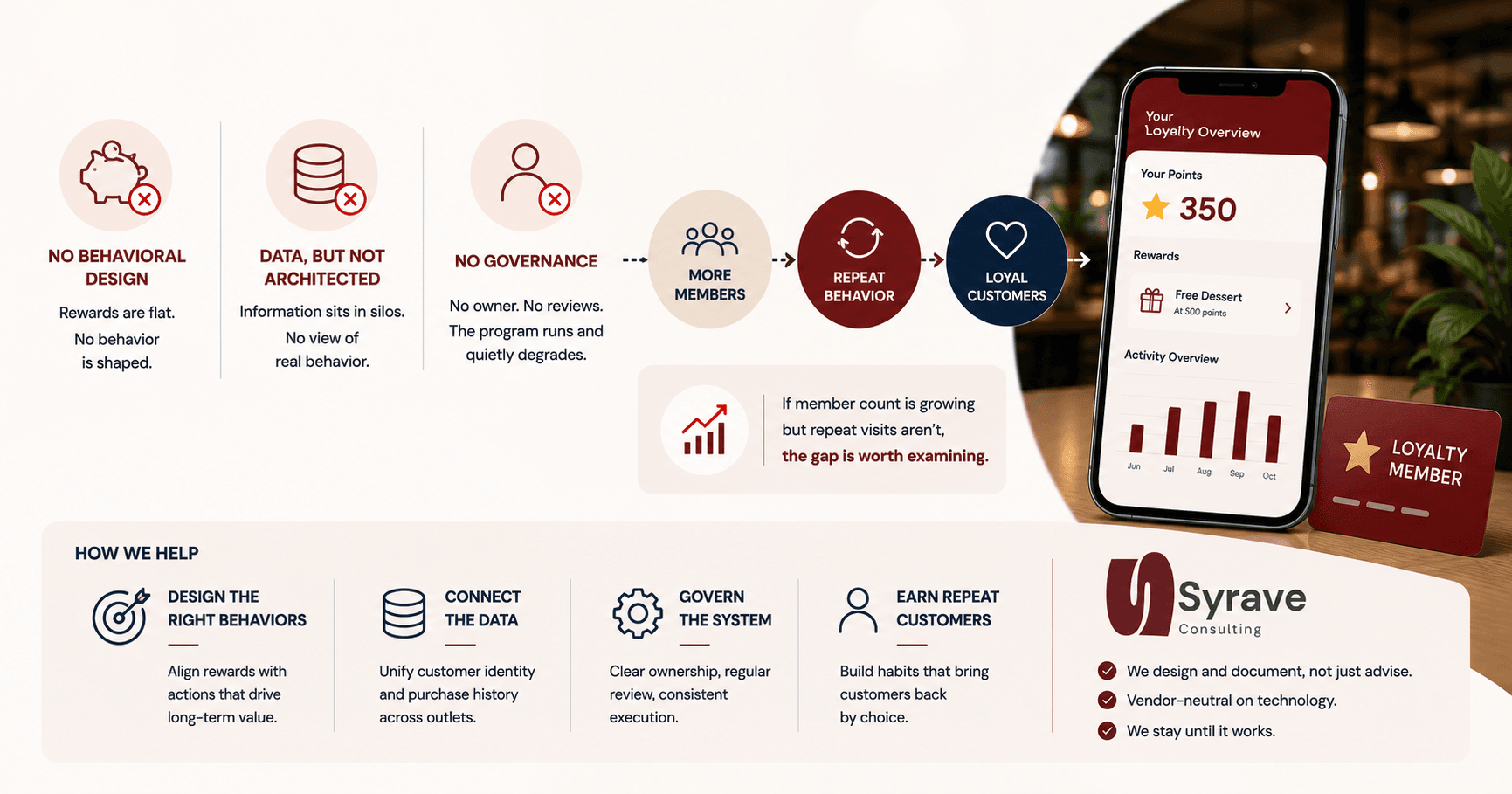
The first structural gap is that customer behavior is rarely designed. Many loyalty programs reward every purchase in exactly the same way, regardless of what the business wants customers to do. Whether the objective is encouraging a second visit within two weeks, introducing a new menu category, or shifting customers from delivery to dine in, every transaction receives the same reward. The program records activity, but it does little to influence future behavior.
The second gap is that customer data is collected but not connected. Membership records and transaction history often remain inside operational systems without providing a meaningful view of customer behavior. Businesses know who has registered, but they may not know who returns regularly, who has become inactive, or which customer activities actually improve retention.
The third gap is governance. Many loyalty programs launch successfully but receive little structured review afterward. Ownership becomes unclear, performance is reviewed inconsistently, and inactive members remain inactive because no defined operating process exists to respond. Without documented operating practices and regular governance, the program gradually becomes another marketing initiative instead of an operational capability that supports long term growth.
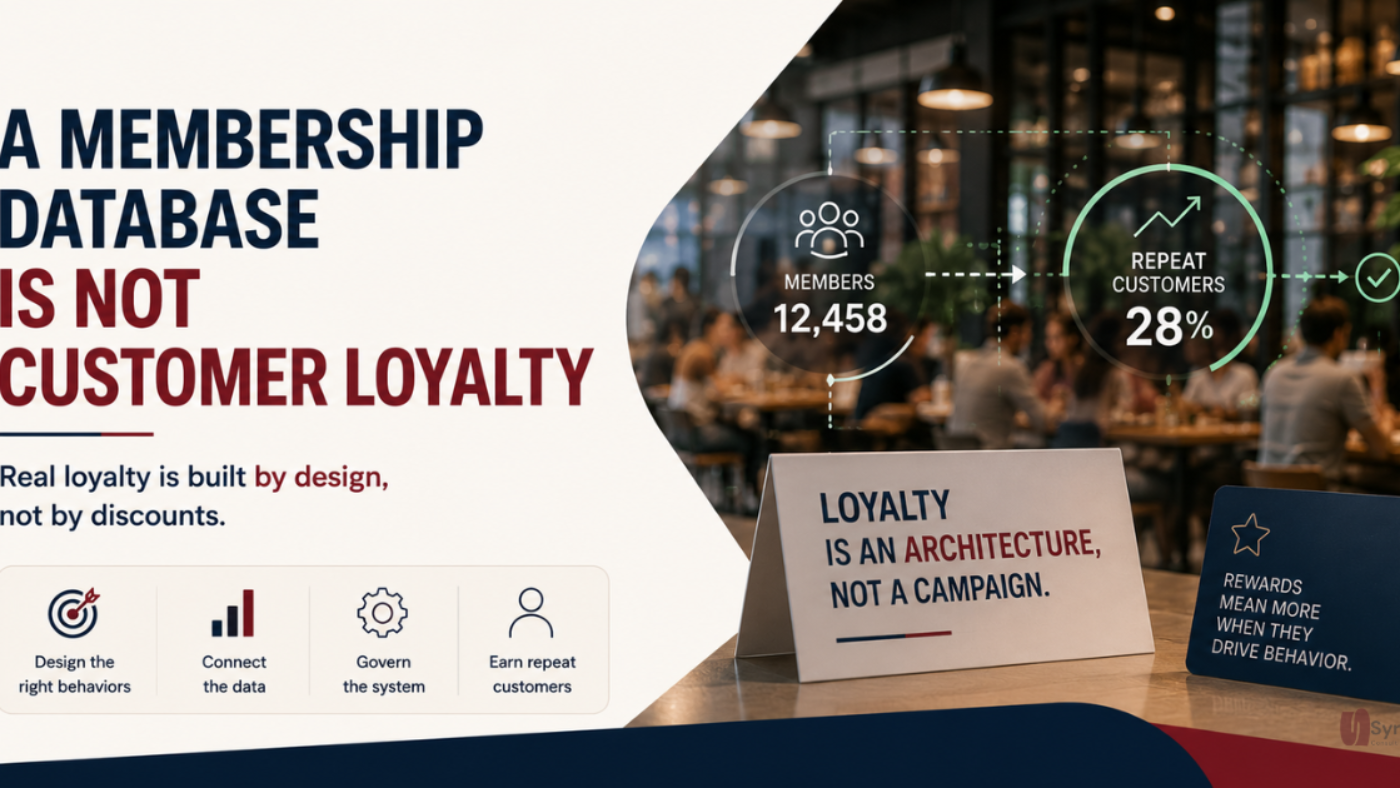
The result is a familiar paradox. Customer registrations continue increasing while repeat purchase behavior remains largely unchanged. A growing membership database should not automatically be interpreted as stronger customer loyalty.
If your membership database continues to grow while repeat visits remain flat, the gap is worth examining. A free discovery call with Syrave can help identify where the program’s design is no longer supporting the business objectives.
Loyalty Is an Architecture, Not a Campaign
Successful loyalty programs are not defined by discounts or the number of points they distribute. They are built around customer behavior. A well designed loyalty architecture identifies which customer actions create long term value, aligns rewards with those behaviors, connects customer identity to purchasing patterns across outlets, and establishes a governance routine that reviews and improves performance over time.
These elements reinforce one another. When one component is missing, the program may continue operating, but it becomes increasingly difficult to influence customer behavior in a meaningful and measurable way. Loyalty should therefore be viewed as an operational capability rather than a marketing campaign. Campaigns have a beginning and an end. Customer loyalty should continue strengthening long after a promotion has finished.
Building Loyalty Requires More Than Rewards
Every business has different customers, operating models, and commercial objectives. A loyalty program that performs well for one restaurant chain may produce very different results for another. Sustainable customer loyalty is rarely created by copying another company’s rewards structure or increasing promotional activity. It comes from designing an operating model that reinforces the behaviors the business wants to encourage and gives teams the structure to manage those behaviors consistently over time.
Organizations that build stronger customer loyalty usually share several characteristics. They establish clear ownership of the program, connect customer data with operational decisions, review performance on a regular basis, and refine the program as customer behavior changes. Loyalty is not treated as a one time project or a series of promotional campaigns. It becomes part of how the business operates every day.
This is the principle behind Syrave’s Customer Loyalty Architecture Design service. We design and document, not just advise, so businesses receive an operating model that can be managed long after implementation. We remain vendor neutral on technology, allowing organizations to build around the systems that best support their operations. We also stay until it works, supporting implementation and early optimization so the design delivers value in day to day operations instead of remaining a document on the shelf. This work strengthens the team you already have. What is usually missing is the connective structure between marketing, operations, and data, the piece no single department can build alone, and that structure is what we design together with your team and hand over to them.
Loyalty Is Built One Behavior at a Time
Customer loyalty rarely weakens because a single promotion ends. More often, it declines gradually because the operating system behind the program was never designed to reinforce repeat behavior consistently. As businesses continue adding new members, it becomes easy to mistake a larger database for stronger customer relationships, even when purchasing patterns remain unchanged.
A successful loyalty program is measured not by how many customers register, but by how many customers choose to return. Repeat customers are built by design, one reinforced behavior at a time.
If your F&B business is investing in promotions but cannot clearly see customer loyalty strengthening, book a complimentary 60 minute Discovery Call with Syrave. No pitches. No commitments. Just a direct review of your current loyalty program and honest feedback on where its architecture can be strengthened: Book a meeting with us now!
Connect with Syrave – Business Operations Consulting
Email: info@syrave.com
Booking a meeting: discovery conversation
Website: syrave.com
Office: Ho Chi Minh City, Vietnam
Leave A Comment