
Most businesses invest heavily to acquire a customer, the transaction happens then the customer disappears.
This is not a marketing problem, it is a structural one.
According to research compiled by industry analysts, increasing customer retention by 5% can increase profits by 25% to 95%. Yet many local enterprises and multi-brand groups across regional markets still operate without a coherent mechanism to keep customers engaged beyond the first purchase.
The pattern repeats across sectors. An automotive dealership closes a sale and loses contact until the next service interval if the customer returns at all. A retail group runs multiple brands under the same ownership but has no way to move a customer from one brand to another. An F&B chain with ten locations treats every visit as a standalone transaction, with no cumulative value for the customer and no data for the business.
The operational consequence is predictable: customers who could have generated recurring and cross-brand revenue instead become one-time buyers. And the teams responsible for serving them have no incentive structure or tooling to change that outcome.
1.Three Patterns That Signal a Broken Loyalty Infrastructure
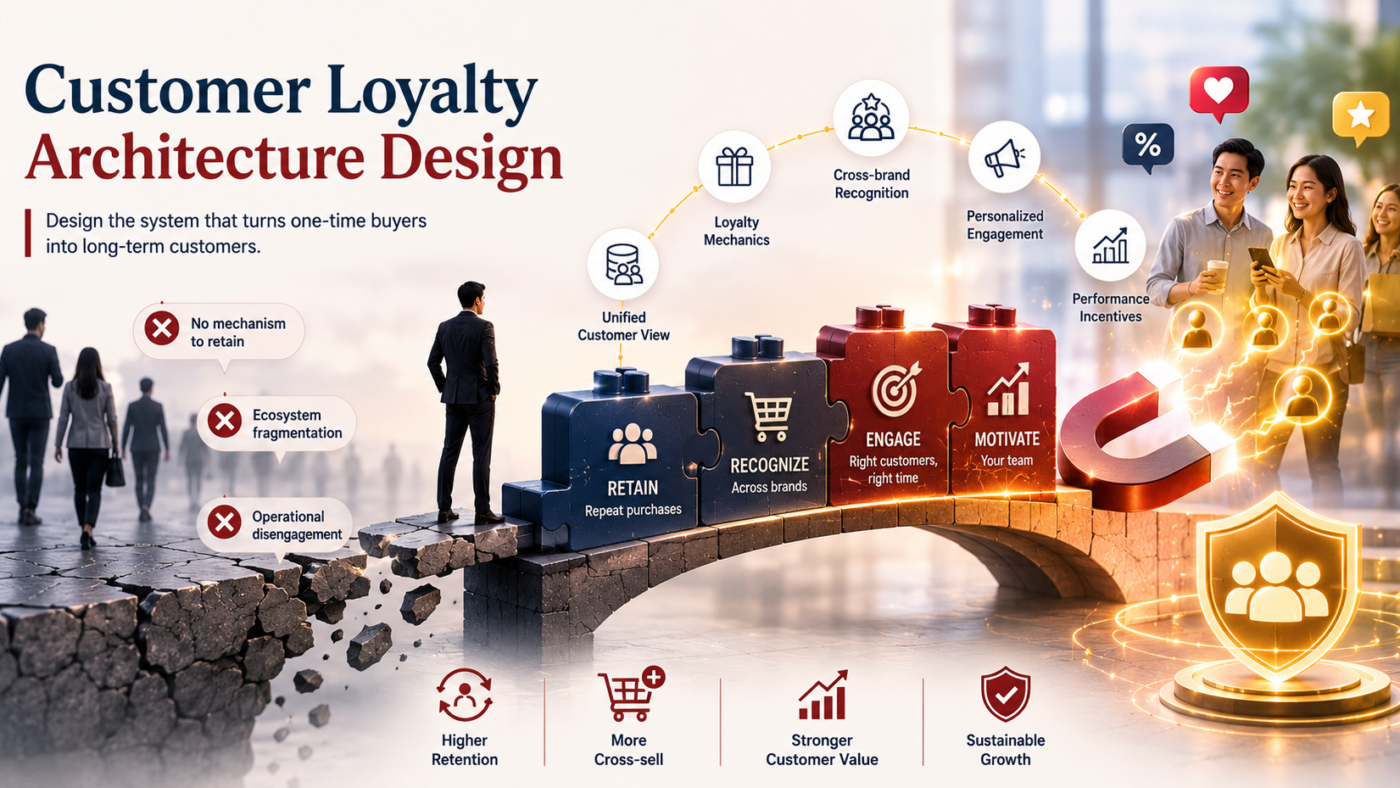
No mechanism to retain: The business has no defined system for rewarding repeat behaviour: no points, no tiers, no structured reason for a customer to return rather than go to a competitor.
Ecosystem fragmentation: For multi-brand groups, customers are siloed by brand. A customer who purchases across three brands is treated as a new contact each time, with no recognition of cumulative value and no incentive to consolidate their spending within the group.
Operational disengagement: Frontline and sales teams are measured on acquisition or single-transaction metrics. There is no incentive structure that motivates them to actively drive retention or cross-sell within the existing customer base.
These are design failures, not execution failures. The infrastructure was never built to support loyalty as an outcome.
Recognise any of these in your own operation? Syrave offers a focused 60-minute Discovery Call to help you identify exactly where the gaps are — no pitch, no commitment.
Book a meeting or email mkt@syrave.vn
2.Why Loyalty Programmes Underperform
Many businesses have attempted some form of loyalty initiative but the results are typically underwhelming.
The most common failure mode is treating loyalty as a marketing campaign rather than an operational system. A points mechanic is launched without defining what behaviour it is designed to reward. Membership tiers are created without a clear value proposition at each level. Redemption options are added without considering whether they are operationally feasible or genuinely motivating to the customer segment.
The second failure mode is building loyalty in isolation from the team that delivers the experience. If the frontline staff or sales teams have no understanding of the programme, no incentive to promote it, and no clear accountability for enrolment or activation rates, the programme exists on paper but not in practice.
The result is a loyalty initiative that costs resources to maintain but generates no measurable change in customer behaviour retention rates stay flat, cross-sell rates remain low, and the business has no clear data on whether the investment is working.
3.Syrave’s Approach: Architecting Loyalty as an Operational System
Syrave approaches customer loyalty as an architecture problem. The goal is to design a system where the mechanics, the operations, and the incentive structures are aligned so that loyalty is an outcome the business actively produces, not a passive hope.
The deliverable from a Syrave engagement is not a recommendation. It is a fully documented loyalty system ready to configure, ready to brief the team on, and built around how your specific business and customer base actually operate.
What that system covers depends on your operation. At minimum, it addresses four outcomes:Customers have a structured reason to return: The earning and redemption mechanics are designed to reward the behaviour that matters most to your business repeat visits, higher spend, or both. The logic is built around your margin constraints and your customer’s actual motivation, not a generic template.
Customers in a multi-brand group are recognized across the portfolio: If you operate more than one brand, a customer’s value should not reset every time they interact with a different part of your business. The loyalty architecture is designed so that recognition travels with the customer and so does the incentive to keep spending within the group.
The right customers receive the right signal at the right time: Retention does not happen through broadcast communication. Customers receive outreach that is relevant to their transaction history and relationship stage. This keeps the programme from becoming noise and keeps engagement rates from declining after the initial launch.
Your team has a reason to drive it: A loyalty system that exists only in the CRM and not in the daily behaviour of your frontline or sales team will not perform. The internal accountability structure, how the team is measured on programme outcomes and how that connects to their own performance is part of the design, not an afterthought.
4. Why Businesses Choose Syrave
We design and document, not just advise: Deliverables from every engagement include implementation-ready mechanics documentation, tier architecture specifications, automation flow maps, and the internal incentive framework structured for execution, not for a presentation.
We are vendor-neutral on technology: Syrave’s loyalty architecture is designed around operational fit and customer behaviour logic. The execution platform is selected based on what serves the business best not on any platform partnership or preference.
We stay until it works: Syrave remains engaged through go-live and into the stabilization period. Enrolment rates, redemption activity, and cross-sell conversion are tracked, and the design is refined based on actual results.
Engagements are structured around transparent milestone billing, with clearly defined deliverables at each stage of the Syrave process: Mobilization, Discovery, Design and Documentation, and Implementation and Optimization.
Syrave works across Vietnam, Singapore, and Malaysia, with cross-industry experience in Automotive, Retail, F&B, Hospitality, and Trading.
5.Build a Loyalty System That Keeps Customers Inside Your Ecosystem
If your customers buy once and do not return or if your multi-brand group has no mechanism to keep spending within the portfolio the problem is structural. A properly architected loyalty system changes customer behaviour and gives your team a framework to actively drive it.
Set aside 60 minutes for a Discovery Call with Syrave. We will help you identify the specific gaps in your current retention infrastructure and outline what a structured loyalty architecture would look like for your business: no pitches, no commitments. Direct audit. Honest feedback.
Connect with Syrave — Business Operations Consulting
Email: mkt@syrave.vn
Booking a meeting at here: discovery conversation
LinkedIn: linkedin.com/company/syrave-consulting
Website: syrave.vn
Office: Ho Chi Minh City, Vietnam
Source: Bain & Company: Prescription for Cutting Costs | Industry loyalty benchmarking data
Leave A Comment