
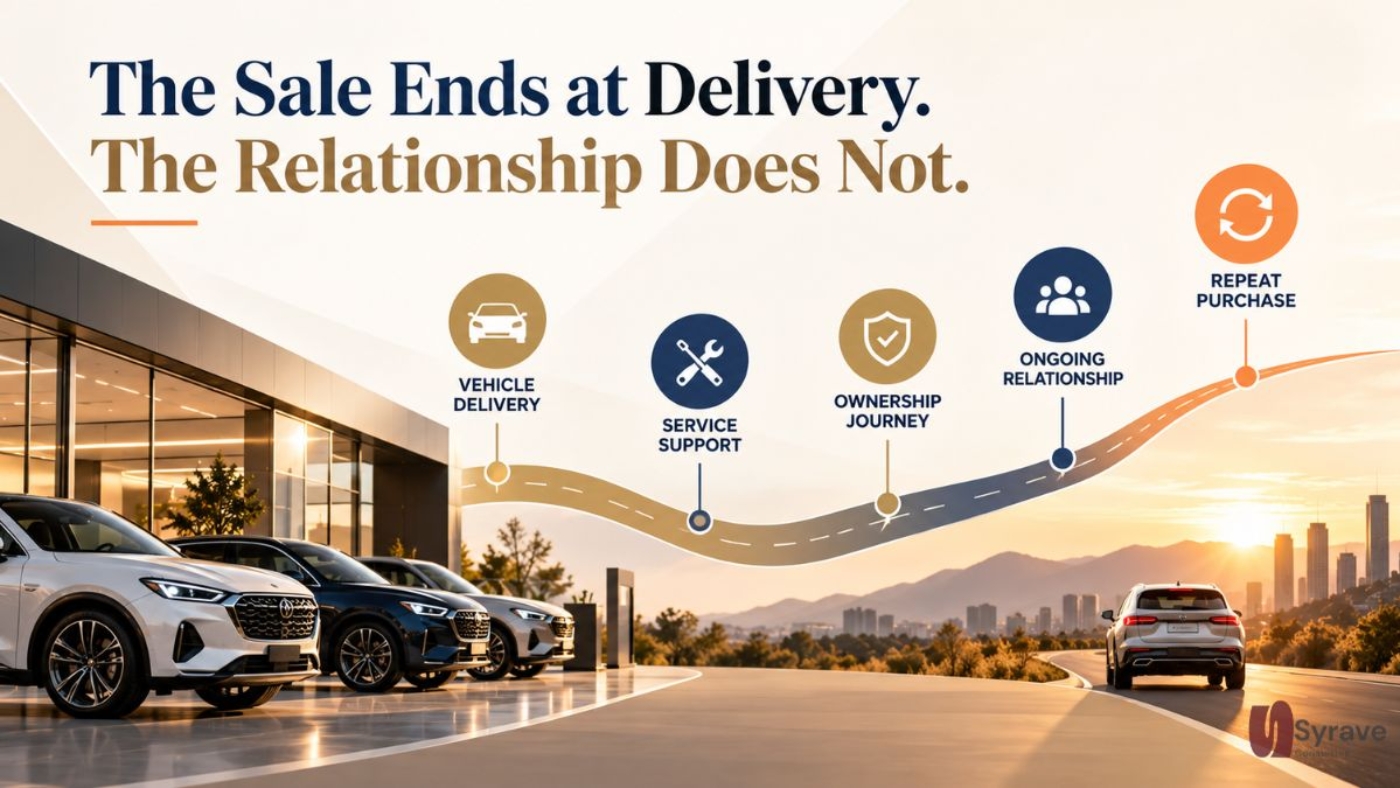
A customer takes delivery of a vehicle. The paperwork is complete, the handover is done well, and the salesperson who managed the purchase moves on to the next buyer. From that afternoon, the customer belongs to no one in particular. The next planned contact is a service reminder, issued when the workshop calendar needs filling.
Automotive customer loyalty depends on what happens after that first transaction. Three or four years later, when the customer replaces the vehicle, the group may discover which brand they chose only if they happen to return. For most dealer groups, the sale is designed in detail, while the ownership period that follows is not designed at all. Building a structured relationship throughout that period is how dealer groups begin to close the gap.
Why Automotive Customer Loyalty Breaks Down After Delivery
The structure explains most of it. Sales is measured on units and on the month. Service is measured on workshop hours and parts. Neither is measured on whether the customer is still with the group at replacement time, which is the outcome that determines the next sale. Nobody is accountable for the span between the two transactions.
What fills the gap is the service reminder. It is useful, and it is the only scheduled contact most owners receive. But it is sent when the business needs the appointment rather than when the customer needs the information, and it asks for something rather than offering anything. A relationship built on that one message teaches the customer that contact from the dealership means they are about to be asked for something.
Meanwhile, the owner’s experience of the brand is being shaped by whoever answers the phone when something goes wrong. That is handled case by case, and it rarely feeds back into any view of the relationship as a whole. By the time the customer is deciding on a replacement, the group has a transaction history and no relationship history.
What Automotive Customer Loyalty Has to Settle
Before any program, application, or campaign, four questions need answers in writing.
The first is who owns the relationship after delivery, since the salesperson’s involvement ends and service owns the appointment rather than the customer. The second is which moments in the ownership cycle are known in advance and deserve a planned contact, as distinct from a reminder issued when the workshop has capacity. The third is what each contact is meant to achieve, because a message whose only purpose is presence trains the customer to ignore the channel. The fourth is where the ownership timeline is held and who keeps it accurate as the customer’s circumstances change.
If your group can report service visits by month but cannot say how many owners are within twelve months of replacing their vehicles, that is worth an hour of conversation.
Using the Ownership Timeline to Plan Customer Contact
The useful thing about this sector is that the important dates are known at the moment of delivery. The purchase date, the model, the warranty term, the finance or lease term, and the typical replacement cycle are all recorded in the deal file. From them, a group can derive when the first service falls due, when the warranty ends, when the agreement matures, and when the customer is likely to be considering a change.
Most dealer groups hold all of that information and use almost none of it as a timeline. A structured approach to automotive customer loyalty turns those dates into a small number of planned contacts, each with a stated purpose, an owner, and a channel, and leaves the rest of the year quiet. Fewer messages with a reason behind them hold attention better than frequent messages without one.
How Syrave Approaches Automotive Customer Loyalty
We design and document, rather than advise and depart. What the group keeps is a written ownership timeline, a named owner for the relationship between transactions, and a reporting view the team can run without us in the room.
We are vendor-neutral on technology. This can be configured into whatever CRM and dealer management system the group already runs, and we have no reason to recommend new software when the gap is in ownership and intent.
We also stay until it works. Our engagements run through four stages: Mobilization, Discovery, Design and Documentation, then Implementation and Optimization. The last one exists because a contact plan that has not run through a full service cycle has not been proven.
This supports the people already holding the relationship together. Your service advisors know which customers they recognize by name, and your sales managers know which owners came back and which did not. What they rarely have is a shared timeline, a defined owner for the quiet months, and time outside the daily operation to agree on it. That is the gap we close, working alongside them.
Start With Owners Due to Replace Their Vehicles This Year
Take the customers whose agreement terms or typical replacement cycles end within the next twelve months and check two things. Who in your group is responsible for them before that decision is made, and what contact are they scheduled to receive? For most groups, the answers are nobody in particular and a service reminder.
Automotive customer loyalty becomes an operational discipline when ownership is clear, contact is planned, and retention can be measured. Dealer groups that establish these foundations are better positioned to maintain customer relationships throughout the ownership cycle and create opportunities for repeat purchases.
Syrave offers a complimentary 60-minute Discovery Call to review how the ownership period is managed, planned, and measured in your group. No pitches, no commitments. Just a direct review of what you have and honest feedback on what is missing.
Connect with Syrave – Business Operations Consulting
Email: ngan.nth@syrave.vn
Book a meeting at here: discovery conversation
LinkedIn: linkedin.com/company/syrave-consulting
Website: syrave.com
Office: Ho Chi Minh City, Vietnam
Leave A Comment