
1. The Operational Reality Behind Declining Service Quality
Most CX breakdowns are not caused by a lack of effort. They are caused by an operational infrastructure that was never designed to scale.
According to an Emplifi survey of over 2,000 consumers, 86% of customers will walk away from a brand after just two or three poor service experiences. That margin for error is narrow. Yet in many businesses across regional markets, the frontline teams responsible for delivering those experiences are operating without clear role boundaries, accountability structures, or documented workflows.
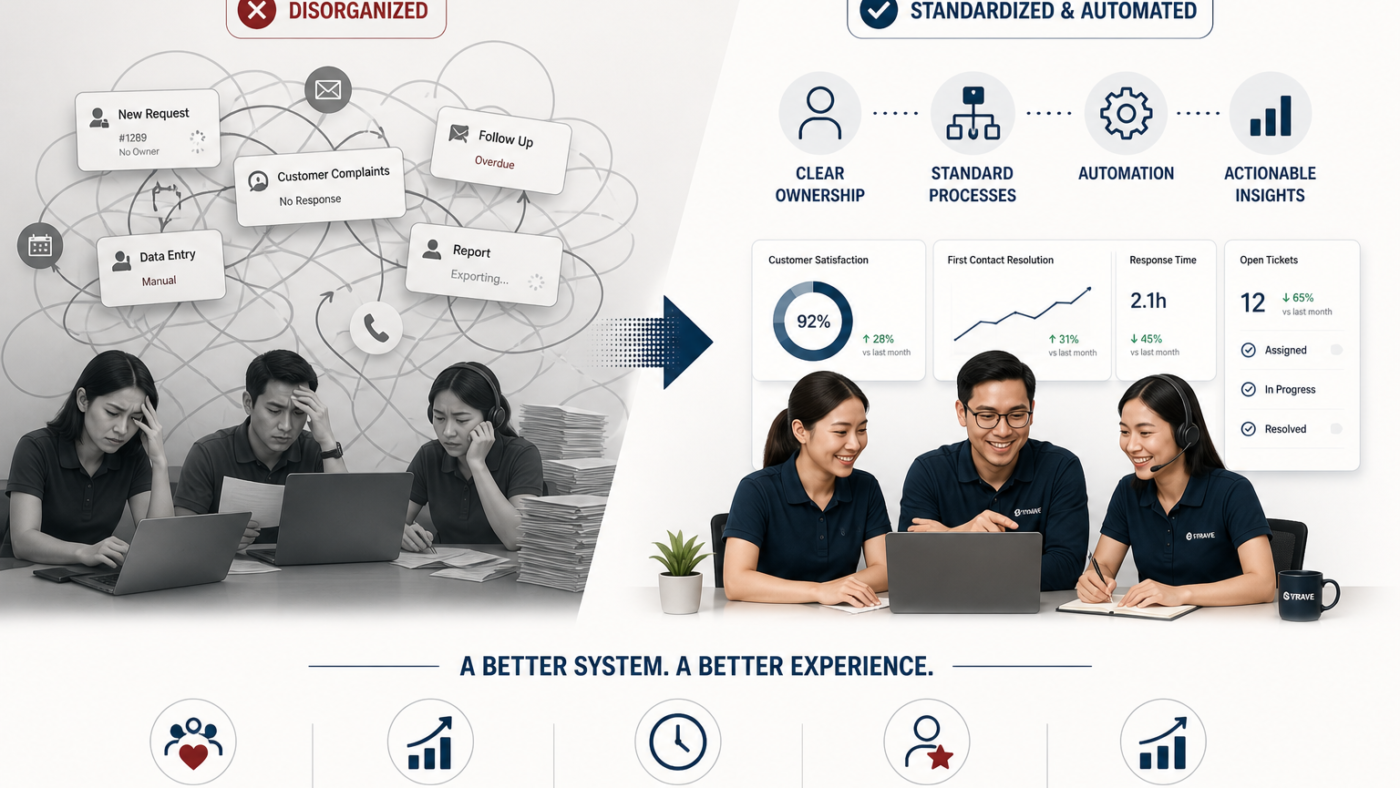
The result is predictable: inconsistent service, high administrative burden on managers, and customer requests that slip through the cracks.
Three Recurring Patterns That Signal a Broken CX Operation
The Double-Role Trap: Customer service staff are expected to handle emotionally demanding interactions while simultaneously reconciling data, managing records, and generating reports. These two functions require different skill sets and different mental states. When combined into one role without clear structure, neither gets done well.
Accountability Ambiguity: When responsibility is undefined, customer requests stall. Teams pass tickets between departments, resolution timelines stretch, and customers are left without answers. The root cause is rarely individual performance — it is the absence of a clear ownership framework.
Administrative Overload at Management Level: When CX managers spend the majority of their working hours manually consolidating data from multiple platforms into a single report, they are not managing — they are producing paperwork. Strategic visibility disappears. Coaching and team development become secondary.
These patterns repeat across industries. Automotive dealerships, multi-brand retail groups, F&B chains — the specific context varies, but the operational failure mode is consistent.
Recognise any of these in your own operation? Syrave offers a focused 60-minute Discovery Call to help you identify exactly where the gaps are — no pitch, no commitment.
Book a meeting or email mkt@syrave.vn
2. Syrave’s Approach: Designing the Infrastructure Behind the Experience
Syrave approaches CX as an operational architecture problem, not a training or motivation problem. The goal is to design a system where every team member understands their responsibilities, every workflow is documented, and repetitive tasks are handled automatically — so that people can focus on what creates genuine value: empathy and resolution.
2.1 Role Architecture
The first intervention is separating service administration from customer engagement. These are distinct functions that require different KPIs, different tools, and different performance metrics.
Service administration covers data accuracy, record management, and reporting. Customer engagement covers direct interaction, complaint handling, and relationship-building.
When each function is properly defined and supported, operational efficiency can increase significantly — not by adding headcount, but by removing structural friction. Syrave has validated this approach through engagements with multi-brand automotive conglomerates in the region.
2.2 The RACI Responsibility Matrix
Syrave applies the RACI framework to every key touchpoint in the customer journey:
• Responsible — who executes the task
• Accountable — who owns the outcome
• Consulted — who provides input before action
• Informed — who needs visibility after resolution
This structure eliminates grey zones. Every customer issue has a single defined owner and a clear resolution path.
2.3 SOPs and Workflow Automation
A CX operation that relies on individual effort to function consistently is fragile. Syrave designs SOPs based on actual workflows — not theoretical best practices — and integrates automation to handle repetitive execution.
Three scenarios Syrave standardizes in every engagement: post-service feedback collection through automated notification channels, maintenance and renewal reminders triggered by transaction history, and escalation protocols that alert senior management when satisfaction scores fall below threshold.
According to industry benchmarking data, businesses with standardized CX operations see First Contact Resolution rates increase from approximately 51% to above 82%. Customers who have a positive service experience are also willing to spend significantly more than those who had a poor one — research places this differential at 140%.
3. Why Businesses Choose Syrave
Syrave’s engagement model is built around one principle: we design and document, not just advise.
Deliverables from every engagement include implementation-ready SOPs, RACI matrices, and role playbooks — not slide decks with recommendations. The team operates across Vietnam, Singapore, and Malaysia, with cross-industry consulting experience across the five sectors we serve: Automotive, Retail, F&B, Hospitality, and Trading.
We are vendor-neutral on technology. Our recommendations are based on operational fit, not platform partnerships. And we stay until it works — remaining engaged through go-live and into the stabilization period, not just through the design phase.
Engagements are structured around transparent milestone billing, with clearly defined deliverables at each stage of the Syrave process: Mobilization, Discovery, Design & Documentation, and Implementation & Optimization.
4. Build a CX Operation That Doesn’t Depend on Heroic Effort
If your CX team is delivering inconsistent results despite working hard, the problem is structural. Operational standardization is not a people initiative — it is an infrastructure investment.
Set aside 60 minutes for a Discovery Call with Syrave. We will help you identify the specific gaps in your current operation and outline what a structured redesign would look like — no pitches, no commitments. Direct audit. Honest feedback.
Connect with Syrave — Business Operations Consulting
Email: mkt@syrave.vn
Booking meeting at here: Discovery
LinkedIn: linkedin.com/company/syrave-consulting
Website: syrave.vn
Office: Ho Chi Minh City, Vietnam
Source: Emplifi Consumer Survey | Harvard Business Review
Leave A Comment