
The pain point
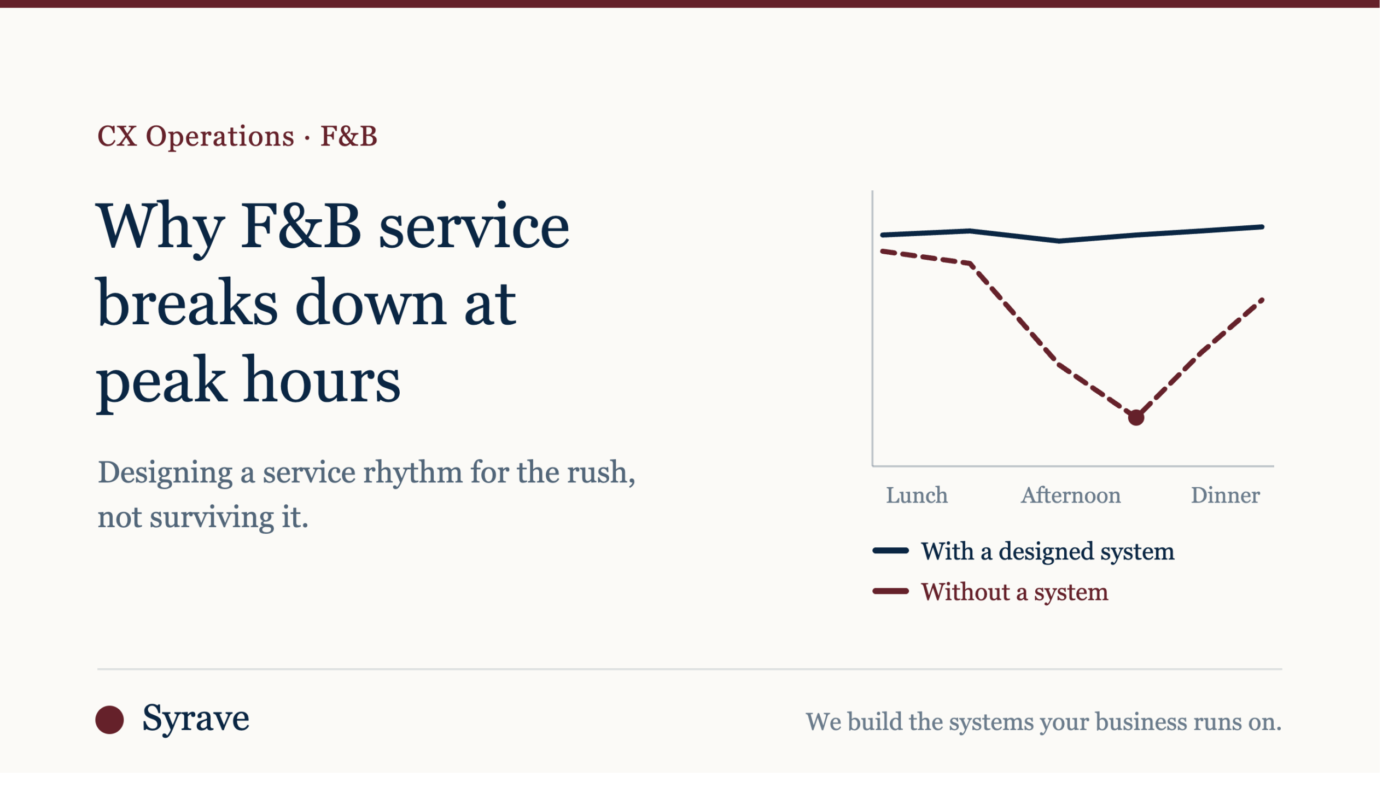
Most F&B teams look capable at 3pm. The floor is calm, orders move cleanly, and guests get attention. The real test arrives at 7pm, when tables turn fast, the queue builds, the kitchen backs up, and three guests need something at once. That is the moment service quality is actually decided, and it is the moment most operations were never designed for.
For regional F&B groups running 50 to 500 staff across multiple outlets, peak hours are where the experience either holds or unravels. A guest rarely remembers a slow Tuesday afternoon. They remember the Friday night when their order was forgotten and no one owned the fix. When the rush exposes the same gaps week after week, that is not a staffing problem. It is an operation that has no defined way to run under load. This is the gap Syrave is built to close.
The diagnosis
Peak-hour breakdowns usually trace back to three structural gaps. There is no defined service rhythm for high-volume periods, so the team improvises and every shift handles the rush differently. Hand-offs between front, kitchen, and floor are informal, so under pressure tickets stall in the space between roles. And there is no escalation threshold, so a small backup becomes a visible failure before anyone steps in.
The pattern repeats across outlets because the rush is treated as something to survive rather than something to design for. Leadership feels it as a ceiling on growth: every busy service is a gamble on whether the experience will hold.
Not sure where your service breaks under load? A short audit can map your peak-hour gaps.
The Syrave framework
CX Operations Standardization treats the rush as a designed operation, not a test of individual effort. We architect a clear service rhythm for high-volume periods: who owns what during the peak, how hand-offs move between front, kitchen, and floor, and at what point a delay triggers a defined response instead of a scramble.
Our engagements move through four stages: Mobilization, Discovery, Design and Documentation, and Implementation and Optimization. We start by observing how your service actually runs at full load today, then design the peak-hour standards, document them in playbooks the floor can follow on a busy night, and stay through rollout until the new rhythm holds during a real rush.
This does not replace your floor team. Your people read the room and carry the service in ways no document can. Standardized peak-hour operations gives them a shared playbook so they are not reinventing the response to every rush, and a clear escalation path so no one is left absorbing a backup alone. Designing that system, and documenting it so it survives a high-turnover floor, is hard to do while also running a packed dinner service. That is where we work alongside your team to build it properly.
Why Syrave
We design and document, not just advise. You are left with peak-hour playbooks your team runs on, not a deck of recommendations. We stay until it works, through implementation and into a real busy period, not just the design phase. And we are vendor-neutral on technology, so any tools fit how your floor actually operates rather than the other way around.
This is the difference between service that survives the rush and service that is built to last through it.
If your service holds when it is quiet but slips when you are busiest, start with a 60-minute Discovery Call. No pitches, no commitments. Just a direct audit of where your peak-hour operation breaks and honest feedback on what to fix first.
We build the systems your business runs on.
Book a call: booking link
Email: mkt@syrave.vn
LinkedIn: Syrave LinkedIn
Website: syrave.com
Leave A Comment