

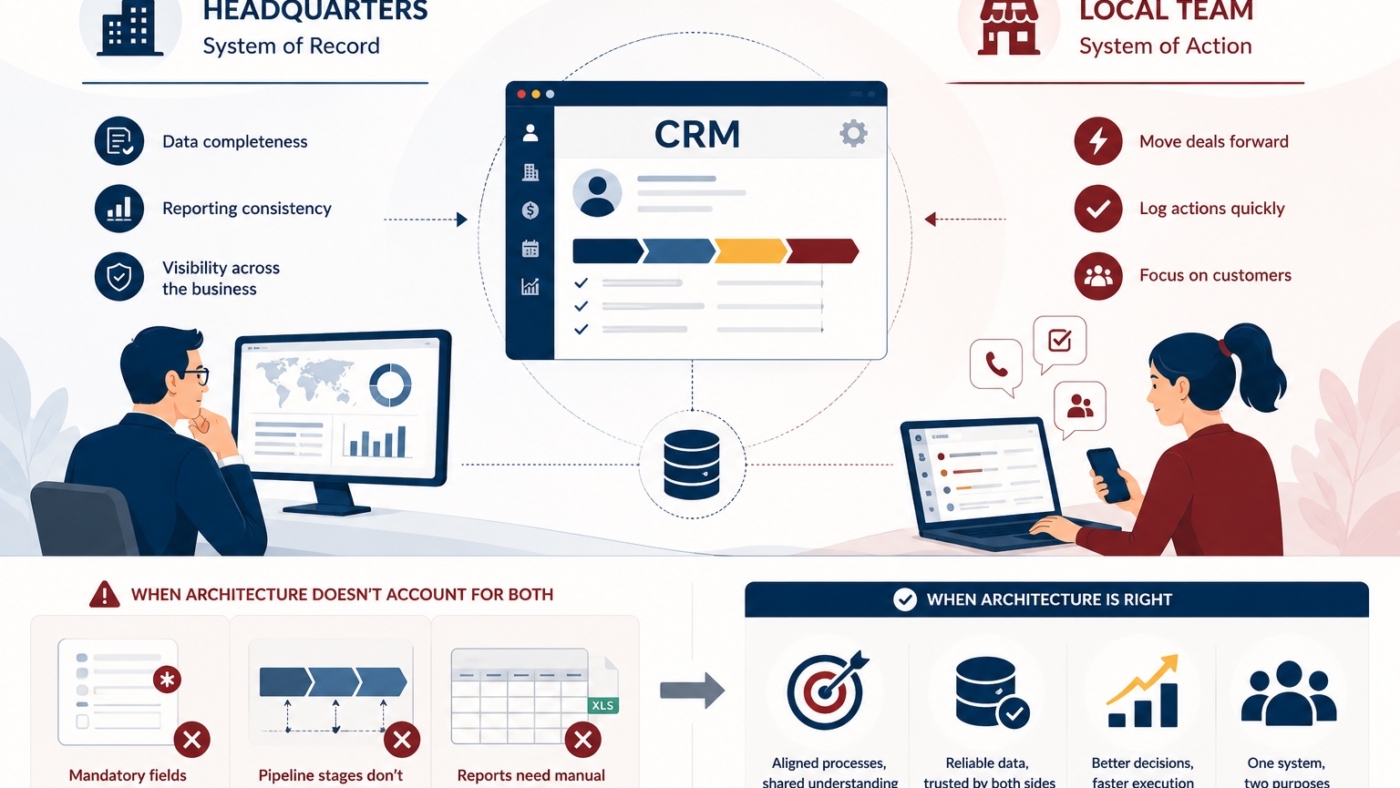
1.The Same System, Two Different Purposes
When a regional business deploys a CRM that was configured at headquarters, both parties tend to assume they are working with the same tool toward the same goal, but in practice they rarely are. Headquarters uses the CRM primarily as a system of record, where the priority is data completeness, reporting consistency, and visibility into what is happening across the business, which is why fields are mandatory, formats are standardised, and reports are expected to arrive in a defined structure on a defined schedule. The local team, by contrast, uses the same system as a tool for action logging a call before the next one starts, updating a deal status before the weekly review, or tracking a lead before it gets buried so for them the CRM is either something that helps them move faster or something that slows them down, and when it slows them down, they find workarounds.
These two modes of use are not inherently incompatible, but when the system is configured for only one of them which is what happens when a headquarters configuration is deployed without redesigning the process layer underneath it, the gap appears almost immediately in the data.
2.Three Places the Gap Becomes Visible
Mandatory fields that local teams leave blank, because fields that are required at headquarters often serve a reporting or compliance function that is relevant at the group level but has no operational relevance locally it does not help the team move a deal forward, and filling it in requires information they do not routinely track, so the field gets left blank, the report at headquarters shows incomplete data, and the assumption becomes that the local team is not following process when the more accurate diagnosis is that the process was designed for a different operational context.
Pipeline stages that do not match how deals move locally, since a global sales process defines stages that reflect how deals are expected to progress across all markets, while in a specific local market the actual progression may follow a different decision-making timeline, involve a different number of stakeholders, or confirm commitment at a different point altogether and when the stages in the system do not reflect how deals actually move, the local team either maps their deals inaccurately or skips stages entirely, so the pipeline data stops reflecting reality and management visibility degrades at both the local and group level.
Reports that require manual reconciliation before they are usable, which happens when the data structure at the local level does not match what headquarters expects to see, so someone at the local or regional level has to extract the raw data, reformat it, and produce a version headquarters can read a task that was never budgeted for, recurs every reporting cycle, and exists only because the configuration was never designed to serve both levels of the organisation simultaneously. Each of these patterns traces back to the same root cause: the system was configured for one operational context and then deployed into another without addressing the layer where the two contexts differ.
If your regional CRM is producing data that requires reconciliation before it is usable at the group level, the architecture needs to be examined. Syrave offers a focused 60-minute Discovery Call to identify exactly where the misalignment is : no pitch, no commitment.
Book a meeting or email mkt@syrave.vn
3.Why This Is a Process Architecture Problem, Not a Compliance Problem
The standard response to inconsistent CRM data is to treat it as a behaviour problem retrain the team, enforce the mandatory fields, audit the pipeline more frequently, and make it clear that the expectation is full compliance. This response is understandable, but it is also consistently ineffective, because it addresses the symptom rather than the cause.
When a local team leaves fields blank, it is rarely because they are unaware of the requirement or indifferent to it it is because filling in the field creates friction with no operational return, since the field was designed for a reporting function at the group level and at the local level it only adds a step without helping the team do their job better, and over time the team learns which requirements have consequences and which do not, with their compliance behaviour reflecting that learning. Retraining does not change this calculation, but redesigning the architecture does.
A CRM that serves both headquarters and the local team is not a compromise between two configurations but a deliberate architecture decision, one that identifies which data points need to be consistent across the organisation, which need to be flexible enough to reflect local operational reality, and how those two requirements are reconciled within the same system. That decision is most effectively made before the configuration is locked, because once a team has been operating within a system for several months, the habits formed around its current configuration are difficult to change the process architecture problem does not get easier to fix with time, it gets harder, since the wrong habits become the established way of working.
4.Syrave’s Approach: Designing for Both Levels of the Organisation
Syrave approaches this problem as a process architecture question before it is a configuration question. The goal is a system that gives headquarters the data consistency and reporting visibility it needs, while giving the local team a configuration that reflects how they actually work without requiring manual reconciliation to bridge the two.
The reporting requirements at the group level are mapped first: Before any local configuration work begins, Syrave identifies what headquarters needs to see which fields, which pipeline stages, which report formats and treats these as non-negotiable parameters within which the local configuration must operate. This prevents the local design from optimising for local usability at the cost of group-level visibility.
The local operational reality is mapped against those parameters: With the group-level requirements established, Syrave works with the local team to understand how deals actually progress in this market, which data points the local team generates naturally in the course of their work, and where the current configuration creates friction that does not serve either level of the organisation. The local configuration is then designed to capture the required data in a way that fits how the team actually operates rather than requiring the team to change how they work to satisfy a system designed for a different context.
The reconciliation layer is eliminated by design, not managed manually: Where the current situation requires someone to manually translate local data into group-level reports, the redesigned architecture removes that step. The data structure at the local level is aligned with what headquarters expects to see, so the report is correct when it is pulled not after a manual formatting exercise.
The output is a configuration that serves both purposes: a system the local team will use consistently because it fits their operation, and one that gives headquarters the data integrity and reporting structure it requires.
5.Address the Architecture Before the Wrong Habits Are Established
The most effective point to resolve a CRM misalignment between headquarters and the local team is before the configuration is locked and before adoption has established the wrong habits across the team, because after that point the problem does not become easier to fix it becomes more expensive, since correcting embedded behaviour requires more effort than designing the right process from the start. If you are overseeing a CRM rollout in a regional market, or managing a system where the data gap between the local instance and the group level has become a recurring problem, the architecture is worth examining now.
Set aside 60 minutes for a Discovery Call with Syrave. We will assess where the misalignment sits in your current configuration and outline what a redesigned process architecture would look like no pitches, no commitments. Direct audit. Honest feedback.
Connect with Syrave — Business Operations Consulting
Email: mkt@syrave.vn
Booking a meeting at here: discovery conversation
LinkedIn: linkedin.com/company/syrave-consulting
Website: syrave.vn
Office: Ho Chi Minh City, Vietnam
Source: Gartner — CRM Data Quality and Governance Research | Forrester Research — Enterprise CRM Adoption Patterns
Leave A Comment