

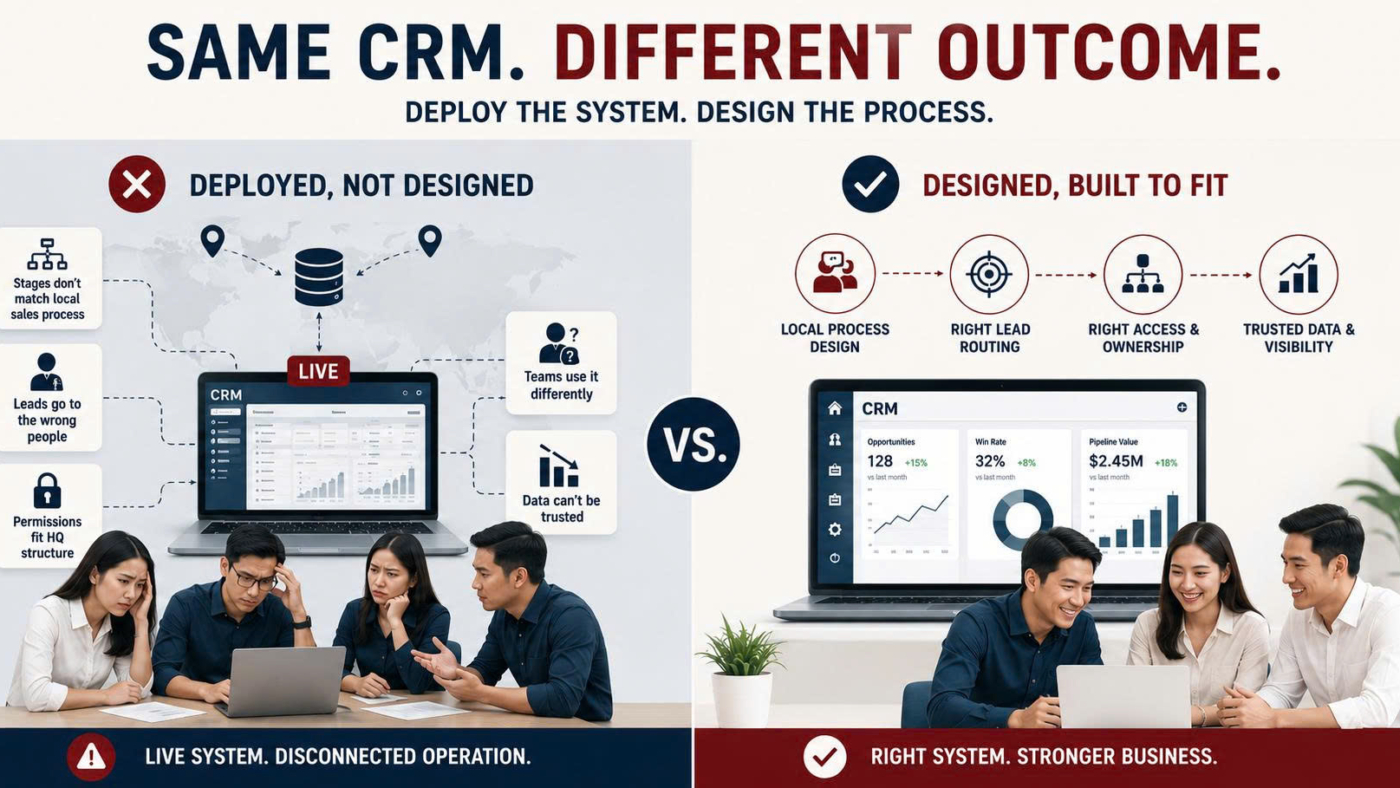
1.The System Goes Live But The Operation Does Not Follow
When a business expands into a new market, the CRM rollout tends to follow a pattern that feels reassuringly familiar. The platform configuration from headquarters is copied across, the interface is translated, regional settings are adjusted, local admin access is granted, and the project is marked complete.
Three months later, the picture looks considerably different. Teams are using the system in inconsistent ways, data fields are being left incomplete, and management at headquarters is pulling pipeline reports that bear little resemblance to what is actually happening on the ground. The CRM is technically live, but the operation behind it is not.
This gap between a system that functions and a process that works is one of the most common and least-discussed outcomes in cross-market CRM deployments. It rarely surfaces as an obvious project failure. Instead, it surfaces as a slow erosion of data reliability and management visibility, long after the implementation team has moved on and the rollout has been declared a success.
2.Why a Headquarters Configuration Does Not Transfer
Sales stages reflect a different deal progression: The pipeline stages configured for the originating market were built around how deals move there: the typical decision timeline, the number of stakeholders involved, and the steps between first contact and signed agreement. In a new market, that progression often looks quite different, and when the stages do not match how deals actually move locally, teams either skip them or apply them inconsistently, until the pipeline data stops being meaningful to anyone who reads it.
Lead assignment logic assumes a different team structure: Routing rules and assignment workflows are built around how the headquarters team is organised, and when the local team has different roles, different coverage areas, or a different split between inside and field functions, the same logic produces the wrong outcomes. Leads reach the wrong person or no one at all, and response time suffers before the process failure has even been identified.
User permissions reflect a different reporting hierarchy: Who can see what, edit what, and receive which reports was configured for the headquarters org structure, and when the local market operates with a different decision-making structure or different management reporting requirements, the permissions layer creates friction in both directions either giving the wrong people visibility into information they should not have, or withholding it from the people who need it to do their jobs.
The local team was not part of designing any of this: A configuration built without input from the team that will use it will always carry gaps that are invisible until go-live. The local team understands how their market operates, how their customers make decisions, and what their management needs to see but that knowledge was never captured, because the design process never asked for it.
These are not edge cases or unusual outcomes. They are the predictable result of treating a CRM rollout as a localisation exercise rather than a process design exercise, and the distinction matters more than most rollout plans acknowledge.
If your CRM rollout in a new market is producing inconsistent data or low team adoption, the process design behind the platform needs to be examined before more configuration work is done. Syrave offers a focused 60-minute Discovery Call to identify exactly where the gap is. No pitch, no commitment.
Book a meeting or email mkt@syrave.vn
3.Two Workstreams That Are Routinely Treated as One
Platform deployment and process design are distinct workstreams that require different inputs, different expertise, and different timelines and when they are treated as a single project, with process design assumed to follow naturally from a completed deployment, the result is a system that is live but not operational in any meaningful sense.
Platform deployment ends at go-live. It covers configuration, data migration, user access, and technical validation, and it can be executed competently by an implementation team with strong platform knowledge and no deep understanding of how the business actually operates in the local market.
Process design, by contrast, begins at go-live. It covers how the team will use the system in practice what each pipeline stage means in this specific market, who handles which lead type, how escalations are triggered, and what data must be captured and at what point in the customer journey. This work requires a genuine understanding of the local operation, the local customer’s decision-making behavior, and what the local management team needs to see in order to run the business with confidence.
The assumption that the second workstream will sort itself out once the first is complete is the single most common cause of CRM underperformance after a market expansion rollout. It does not sort itself out. Teams develop their own informal workarounds, data quality degrades steadily, management begins requesting reports that cannot be trusted, and eventually stops requesting them altogether. By the time the problem is visible enough to act on, months of unreliable data have accumulated, and correcting the habits the team has built takes significantly more effort than establishing them correctly from the start.
4.One Question Worth Asking Before the Rollout Begins
If your team is preparing a CRM rollout in a new market, one question is worth raising before configuration begins: are you deploying a platform, or are you designing a process that the local team can actually operate?
The answer to that question determines whether the system produces reliable data and consistent adoption or goes live as a technically complete project that does not change how the team works, and quietly erodes management confidence in the months that follow.
Set aside 60 minutes for a Discovery Call with Syrave. We will assess your rollout plan, identify what process design work needs to happen before or alongside the platform deployment, and tell you directly where the gaps are. No pitches, no commitments, direct audit and honest feedback.
Connect with Syrave — Business Operations Consulting
Email: mkt@syrave.vn
Booking a meeting at here: discovery conversation
LinkedIn: linkedin.com/company/syrave-consulting
Website: syrave.vn
Office: Ho Chi Minh City, Vietnam
Source: Gartner — CRM Implementation Success Factors 2024 | Forrester Research — CRM Adoption and ROI
Leave A Comment