
For mid-sized enterprises across Southeast Asia, a new CRM platform has become a standard milestone of digital transformation. The investment is significant, the expectations higher and the results, by most measures, disappoint.
The pattern is well established. For years, industry research has consistently found that a large share of CRM rollouts fail to deliver what they were meant to. Digital transformation projects more broadly tell the same story, most fall short of their original objectives.
What this rarely explains is why. For a growing retail group, automotive dealer network, F&B chain, or trading company in the 200–1000 employee range, the reason matters far more than the trend itself.
This is the question CRM Architecture Consulting is built to answer.
1. The problem is rarely the platform
When a CRM rollout underperforms, post-mortems tend to focus on the software, the wrong vendor, missing features, a difficult interface. The evidence points elsewhere.
Poor data quality is repeatedly identified as one of the leading operational challenges enterprises face, and user adoption not technology is the factor most often blamed when CRM projects underperform. Both are symptoms of the same root cause: the system was deployed before the workflows and data it depends on were ever designed.
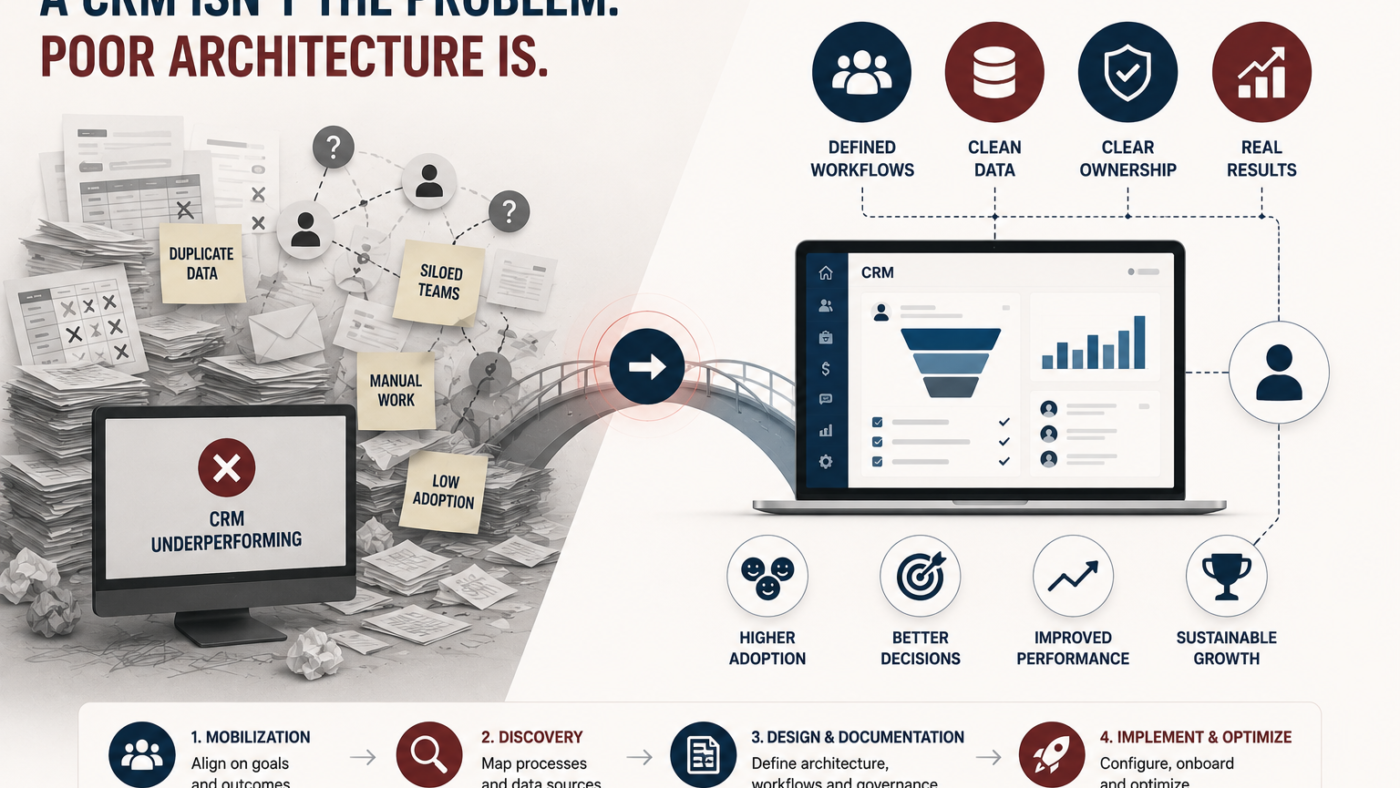
In practice, that looks familiar. Sales quietly returns to spreadsheets. The same customer appears under three branch records. Two reports answer the same question differently, and trust in the data erodes.
For decision-makers, the takeaway is direct: a CRM cannot fix a process that was never defined.
2. Where the architecture breaks
A closer look at underperforming rollouts tends to surface the same structural gaps:
- The CRM was procured, not designed. Configuration began before anyone mapped how a lead becomes a customer, or how after-sales data returns to the same record.
- “Customer” is defined inconsistently. Sales, marketing, and service each use their own definition, and records fragment on entry.
- Existing workflows were never replaced. Teams kept old habits, so the platform runs alongside the old process rather than absorbing it.
- No ownership after go-live. Without governance, data quality drifts and the system reverts to a costly contact list.
The common thread is sequence. Technology was selected and switched on before the operating model beneath it was documented which is why customer information continues to slip through the cracks.
A short architecture review can usually pinpoint where a stalled rollout is breaking often before any reconfiguration is needed.
3. Designing the layer beneath the software
CRM Architecture Consulting treats the system as an operating model first and a software decision second. At Syrave, the work runs through four defined stages:
- Mobilization: align leadership on objectives, scope, and measurable outcomes.
- Discovery: map current workflows and data sources, and locate where customer information breaks down.
- Design & Documentation: define the target architecture: data model, workflows, ownership, and the governance rules that keep the system clean.
- Implementation & Optimization: support configuration, software onboarding, and the early adjustments that convert a new platform into routine practice.
Software onboarding is deliberately placed in the final stage. A tool is introduced only after the workflow it supports is designed and agreed the sequence that research repeatedly links to higher adoption.
Because Syrave is vendor-neutral on technology, the architecture is settled before the platform is chosen, not the reverse. The engagement also designs and documents the system workflow maps, data definitions, and governance rules a team can operate independently rather than delivering advice alone. Syrave stays until it works through go-live and early optimization, and engagements run on transparent milestone billing, so cost tracks delivery throughout.
4. A system built to last
CRM failure is rarely a technology problem which means it is rarely beyond a company’s control. When workflows are designed, customer data is defined, and ownership is clear, a new platform stops being a risk and becomes infrastructure the business can scale on.
For any enterprise mid-way through digital transformation, that is the difference between a tool teams tolerate and a system they rely on.
Book a free 60-minute Discovery Call. No pitches, no commitments a direct audit of where your CRM workflow stands today, and honest feedback on what to address first.
Connect with Syrave — Business Operations Consulting
Email: mkt@syrave.vn
Booking a meeting at here: discovery conversation
LinkedIn: https://www.linkedin.com/company/syrave-consulting/
Website: syrave.vn
Office: Ho Chi Minh City, Vietnam
Leave A Comment