

1. The Gap Between Go-Live and Actually Working
There is a moment most operations leaders recognise. The contract is signed. The data has been migrated. The go-live date is confirmed. There is cautious optimism in the building. Finally, a system that will bring everything together.
Six months later, the sales team has quietly returned to their spreadsheets. The marketing team is still pulling reports by hand. The customer service team is coordinating through informal messaging channels because the CRM tickets do not reflect how they actually work. Leadership is still without reliable pipeline visibility every Monday morning.
The CRM that took months to evaluate, negotiate, and implement has become the most expensive, least-used piece of software in the company.
This is not a software problem. It is not a people problem. It is an architecture problem.
And it is more common across regional enterprises than anyone in this industry wants to acknowledge.
2. Three Moments When a CRM Stops Working
Before Go-Live
Configuration is completed by people who know the software but not the business. They work from the vendor’s default implementation templates generic pipeline stages, standard field types, out-of-the-box automation. The system goes live on schedule and the project is declared a success.
But the system reflects how a generic business is supposed to operate, not how this specific business actually operates. That distinction matters more than most implementations acknowledge.
The First 90 Days
This is when the gap between the system and operational reality becomes impossible to ignore. Staff encounter workflows that do not match how they think, fields that do not capture what they need, and automations that trigger at the wrong time.
Rather than changing how they work which almost never happens sustainably they work around the system. Informal processes emerge. Unofficial tracking channels become the real source of truth. The official system becomes a place where data is recorded after the real work is already done elsewhere.
The Slow Administrative Creep
This failure mode is the most difficult to detect because it does not feel like failure it just becomes how things are. Managers spend Monday mornings extracting data from the system and reformatting it manually because the built-in reports do not answer the questions leadership actually asks.
The tool that was supposed to provide real-time visibility now requires days of manual work to produce a usable summary. The CRM becomes something to maintain rather than something to use.
All three failure modes trace back to the same root cause: the architecture was not designed before implementation began.
If any of these patterns are familiar, the issue is structural — not the software itself. Syrave offers a focused 60-minute Discovery Call to help identify exactly where the architecture is breaking down.
Booking meeting now or email mkt@syrave.vn
3. What CRM Architecture Actually Means
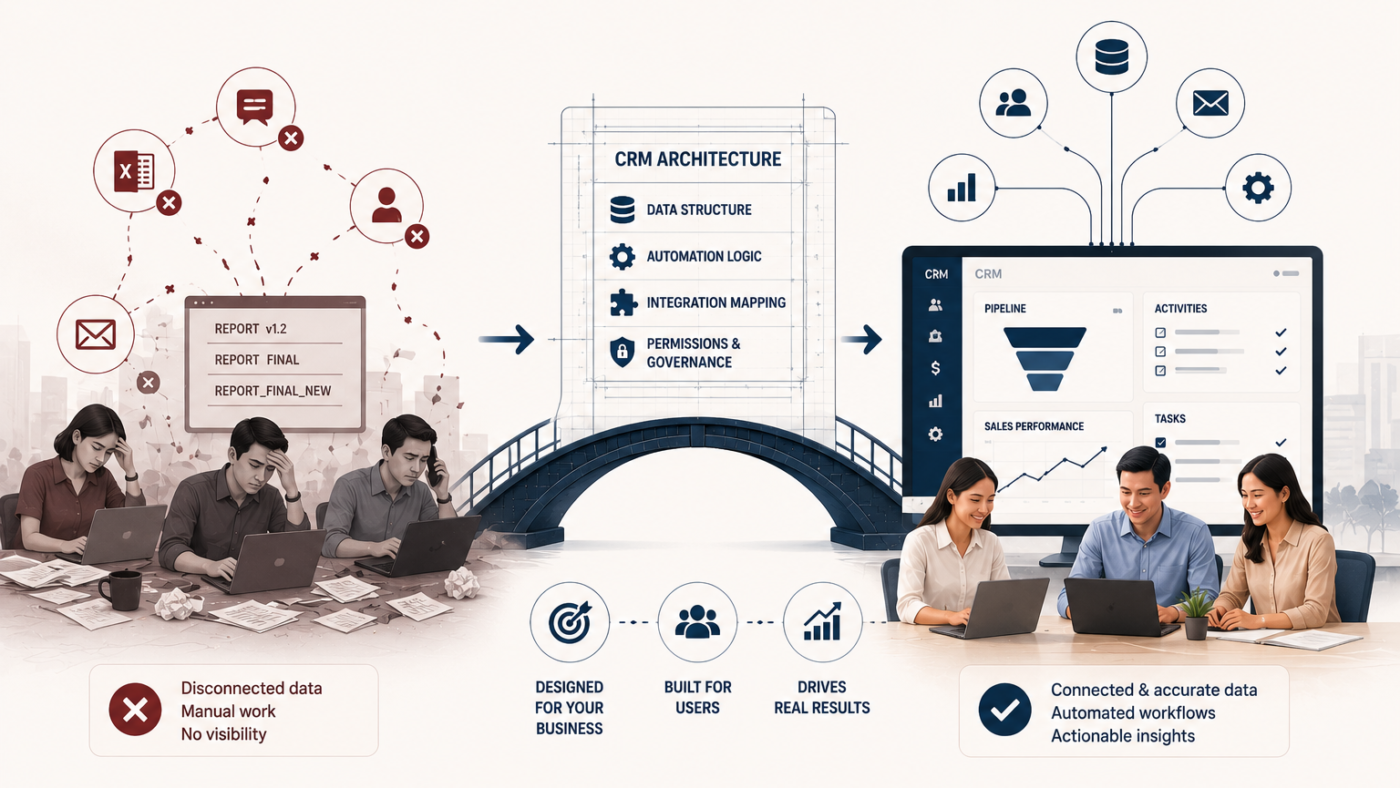
Architecture is not a technical diagram or a server configuration. It is the set of foundational decisions that determines whether a system serves the people using it or becomes something they work around.
These decisions happen before any configuration begins. They span four domains, and getting any one of them wrong creates problems that compound across everything else.
• Data structure: How customer records are defined what constitutes a contact, an account, a lead and which fields are mandatory, which are optional, and why. Poor data structure makes every report slightly wrong and every analysis rest on a foundation that shifts quietly over time.
• Automation logic: What the system should handle automatically and what requires human judgment. Automation without clear business rules creates noise, alerts that go unread, follow-up sequences that fire to the wrong person, and eventually, automations that are quietly disabled because they cause more problems than they resolve.
• Integration mapping: How the CRM communicates with other platforms across the business. When integration is not designed deliberately, data conflicts emerge between systems. When data conflicts, nobody trusts any of it and everyone maintains their own version, recreating the silos the CRM was purchased to eliminate.
• Permissions and governance: Who can see, edit, and own each type of record. Governance that is not designed intentionally defaults to one of two failure modes: too open, creating data exposure and pipeline conflicts, or too closed, requiring constant access requests and creating bottlenecks that slow down daily operations.
4. The System Should Fit the Business
CRM platforms are designed to be flexible, but they carry built-in assumptions about how pipelines are structured, how leads are qualified, and how customer data is organised. When implementation is compressed when the priority is to go live quickly rather than correctly the path of least resistance is to accept the system’s default settings.
The result is a system that works, but with constant friction. Terminology does not match how the team thinks. Stages do not reflect how deals actually progress. Reports require manual reformatting to answer the questions leadership actually asks.
CRM architecture consulting reverses this dynamic. The system is designed to fit the business its real processes, its actual terminology, its specific team structure. When that alignment is in place, adoption is not a change management challenge. People use the system because it reflects how they already work.
5. Why Businesses Choose Syrave
Syrave does not configure systems and then hand them over. The engagement model is built around one principle: we design and document, not just advise.
We are vendor-neutral on technology: Platform selection is a recommendation based on operational fit, not software partnerships or certification preferences. The right CRM is the one whose native data model aligns most naturally with how the business actually operates.
We stay until it works: Support continues through go-live and the first weeks of real-world use including the edge cases that emerge when actual customers interact with actual processes. Success is not measured by whether the system is technically live. It is measured by whether the team has stopped working around it.
Engagements are structured around transparent milestone billing, with clearly defined deliverables at each stage. The team operates across Vietnam, Singapore, and Malaysia, with cross-industry experience across the five sectors we serve: Automotive, Retail, F&B, Hospitality, and Trading.
6. If Any of This Sounds Familiar
If your team spends more time working around the CRM than using it, the issue is rarely the software. Shadow spreadsheets still exist. Monday reports take days to produce. Leadership lacks reliable pipeline visibility. These are not system failures they are symptoms of structural problems in the architecture.
The fix is not switching platforms, adding training, or cleaning up the data. It is returning to the blueprint: defining clearly what the system needs to do, designing it with intention, and building exactly what was designed.
Set aside 60 minutes for a Discovery Call with Syrave. We will identify exactly where the current architecture is breaking down and outline what a structured redesign would look like: no pitches, no commitments. Direct audit. Honest feedback.
Connect with Syrave — Business Operations Consulting
Email: mkt@syrave.vn
Booking a meeting at here: discovery conversation
LinkedIn: linkedin.com/company/syrave-consulting
Website: syrave.vn
Office: Ho Chi Minh City, Vietnam
Leave A Comment