
1.The Decision That Feels Safest Is Not Always the Fastest
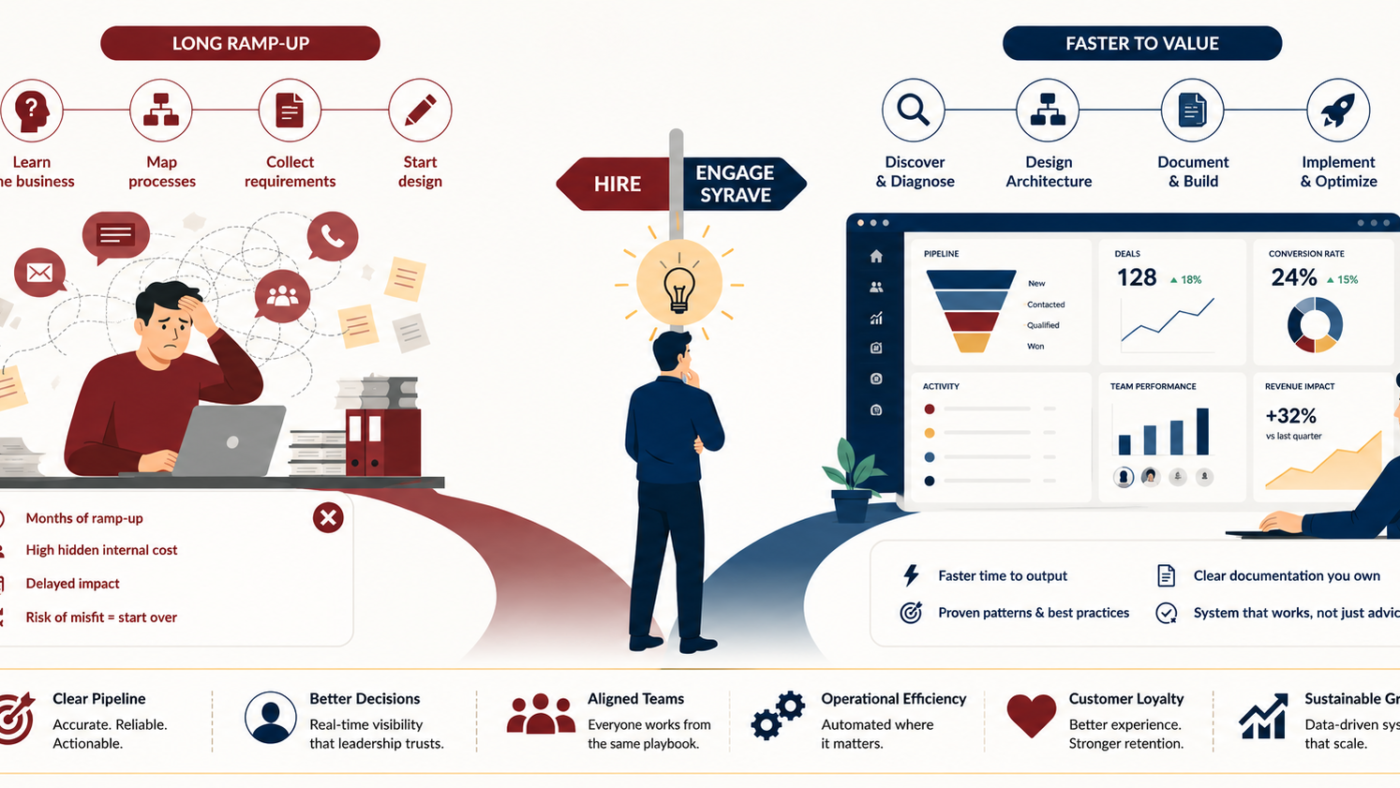
When a business decides it needs someone built properly or rebuilt after a failed implementation the instinct is often to hire:
• Bring in someone
• Give them full context
• Let them own it.
It is a reasonable instinct. A dedicated hire means full attention on the problem, no competing priorities, and someone accountable internally for the outcome. But the instinct tends to underestimate one thing: how long it takes before any output appears.
2.The Cost That Does Not Show Up in the Salary Calculation
The first few months rarely create the kind of progress leadership expects. Even when the new hire is highly capable, there is an unavoidable period of learning before meaningful work can begin. They need time to understand how the business actually operates, how deals move through the organization, how teams interact, and where the current system is creating friction or breaking down that adjustment period is not a sign of underperformance. It is simply the reality of stepping into a new environment.
As a result, the design work leadership is waiting for does not start on day one. It starts only after enough context has been built to make informed decisions.
What often gets overlooked is that the ramp up period carries costs that rarely appear in the original business case. Salary is easy to calculate, but the internal time spent onboarding is not. Leaders and team members invest hours answering questions, explaining processes, joining alignment meetings, and transferring operational knowledge. Once that hidden effort is included, the real cost of the first several months looks very different from the number written in the offer letter.
The timeline to meaningful output also stretches further than expected. By the time the design work is completed and the team is operating within a system that genuinely reflects how the business works, the elapsed time from hiring to measurable impact is often significantly longer than originally planned. For businesses waiting on reliable CRM visibility and operational improvements, that delay creates costs that continue to accumulate.
If the hire ultimately turns out not to be the right fit, the entire cycle begins again. Another search process starts, another onboarding period follows, and more time passes before tangible results appear.
None of this means hiring is the wrong decision. It simply means the full cost of the decision deserves to be understood before the decision is made.
If you are weighing how to build or rebuild your CRM architecture, Syrave offers a focused 60-minute Discovery Call to help you assess the options clearly: no pitch, no commitment.
Book a meeting or email mkt@syrave.vn
3.What the Ramp-Up Period Actually Costs
The gap between making a hire and having a system that genuinely works is not a sign of weak management. It is a built in characteristic of how in house hiring works and one that businesses consistently underestimate at the decision stage.
When a senior specialist joins from outside the organization, they do not arrive with the operational context that makes CRM decisions effective. They still need time to understand how deals actually move through this business, which pipeline stages reflect real buying behaviour, which data points leadership relies on to make decisions, and which workflows officially exist inside the CRM versus those that have quietly migrated into spreadsheets, manual trackers, or group chats because the system never fully supported them.
Building that understanding takes time, and during that period the business is paying for work that sits upstream from any visible output. Progress is being made, but much of it happens below the surface through observation, alignment, and context building rather than through immediate deliverables.
The equation starts to shift when experience reduces the need for ramp up. A team that has already designed CRM and lead management systems across different industries arrives with pattern recognition that accelerates the diagnostic process. The signals that indicate specific operational gaps, broken workflows, or data reliability issues are already familiar.
Questions that might take a new internal hire months to answer through trial, observation, and repeated iteration can often be answered in a matter of weeks through structured discovery and proven frameworks. The result is not faster work for the sake of speed, but faster movement toward a system that reflects how the business actually operates and starts creating value sooner.
4.A Different Starting Point
Syrave approaches CRM architecture engagements with cross-industry experience across businesses in Automotive, Retail, F&B, Hospitality, and Trading. The discovery phase is structured around what we have already learned to look for the recurring points where CRM configurations fail to reflect how teams actually work, where pipeline data stops being reliable, and where management visibility degrades without a clear cause.
That starting point shortens the path from engagement to output. Not because the design is templated every business has a configuration specific to how it operates but because the diagnostic work does not begin from zero.
Discovery is faster because the questions are better: When the team conducting discovery has seen the same failure patterns across multiple implementations, the right questions surface earlier. The design work begins with more complete information, in less time, than a ramp-up period typically allows.
Design produces documentation the internal team can operate independently: Every Syrave engagement delivers implementation-ready documentation: pipeline architecture, data standards, routing logic, user permission structures, written for the people who will use and maintain the system after the engagement ends. The internal team does not need to reconstruct the rationale behind every design decision because it is captured in the documentation they receive.
The engagement ends with a system that works, not a handover that requires further interpretation: Syrave remains engaged through go-live and into the stabilization period. If the configuration produces unexpected outcomes in real usage, those are addressed within the engagement not escalated to a follow-on project or left for the internal team to resolve.
5.Why Businesses Choose Syrave
We design and document, not just advise: The deliverable from every engagement is a working system with full operational documentation not a set of recommendations for the internal team to implement. Stage definitions, routing rules, data governance standards, and permission structures are built, tested, and handed over in a format the team can use from day one.
We are vendor-neutral on technology: CRM architecture recommendations are based on what fits the business operationally not on platform familiarity or partnership arrangements. If the existing platform can be configured to meet the requirement, that is the recommendation. If it cannot, the alternatives are assessed on operational merit.
We stay until it works: The engagement does not close at go-live. Syrave tracks adoption, data quality, and management visibility through the stabilization period, and adjusts the design if real-world usage reveals gaps that were not visible in testing.
Engagements follow four stages: Mobilization, Discovery, Design and Documentation, and Implementation and Optimization with transparent milestone billing at each stage. Scope and cost are defined before work begins, not adjusted as the engagement progresses.
6.The Question Worth Asking Before the Job Description Goes Out
The decision between hiring and engaging an external team is worth making with the full cost calculation in view not just the salary line, but the ramp-up period, the internal time invested in onboarding, and the timeline to first output.
For some businesses, a senior in-house hire is the right long-term answer. For businesses that need a working system sooner rather than later, or that want the design work completed before bringing someone in to operate it, the calculation looks different.
Set aside 60 minutes for a Discovery Call with Syrave. We will assess your current situation, outline what a CRM architecture engagement would involve for your specific operation, and give you an honest view of how the options compare — no pitches, no commitments. Direct audit. Honest feedback.
Connect with Syrave — Business Operations Consulting
Email: mkt@syrave.vn
Booking a meeting at here: discovery conversation
LinkedIn: linkedin.com/company/syrave-consulting
Website: syrave.vn
Office: Ho Chi Minh City, Vietnam
Source: SHRM — The True Cost of Hiring Research | Gartner — CRM Implementation and Adoption Benchmarks
Leave A Comment