

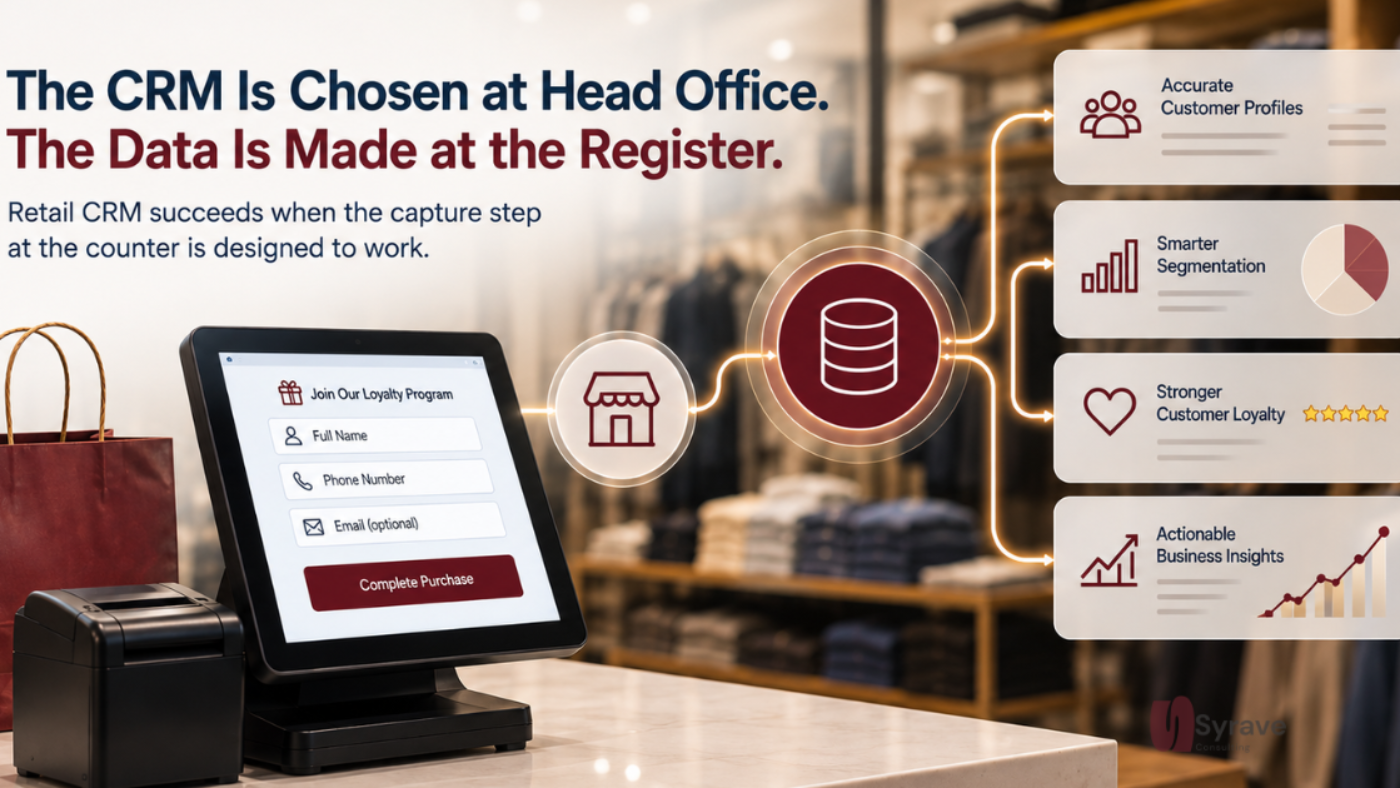
A retail group selects a CRM platform, runs the demonstrations, trains the store teams, and goes live on schedule. Six months later, head office tries to build its first real segmentation and finds that a large share of the customer records cannot be relied on. Names are entered inconsistently, contact numbers are incomplete, and the same shopper exists three times.
Nothing failed at go-live. The project was managed as a technology rollout, when the part that decides the outcome happens at the register, in the seconds between a queue forming and a receipt printing. Retail CRM onboarding succeeds or fails in that interval, and it is rarely settled by a training session.
Why the Register Decides Your CRM Data Quality
Head office chooses the platform, defines the fields, and sets the reporting the board will eventually see. None of that creates a single customer record, because customer records are created by a cashier at the end of a transaction, usually with people waiting, often on a shared terminal, and sometimes at the end of a long shift.
In that moment, the incentive is speed. If a field is optional, it gets skipped; if a contact number is already attached to another record, the fastest resolution may be to create a new one; and if the customer hesitates, the safest move may be to leave the field blank or enter something that lets the screen advance.
None of this is carelessness. It is a rational response to a process that asks for customer data without deciding how it should be collected under real trading conditions. The result is a database that looks populated but cannot be trusted.
Every later initiative inherits that ambiguity, from segmentation and loyalty tiers to comparisons between stores. The group eventually ends up debating the numbers instead of acting on them, which is why CRM data quality in retail starts at the point of capture rather than in the reporting layer.
What Retail CRM Onboarding Must Settle Before Go-Live
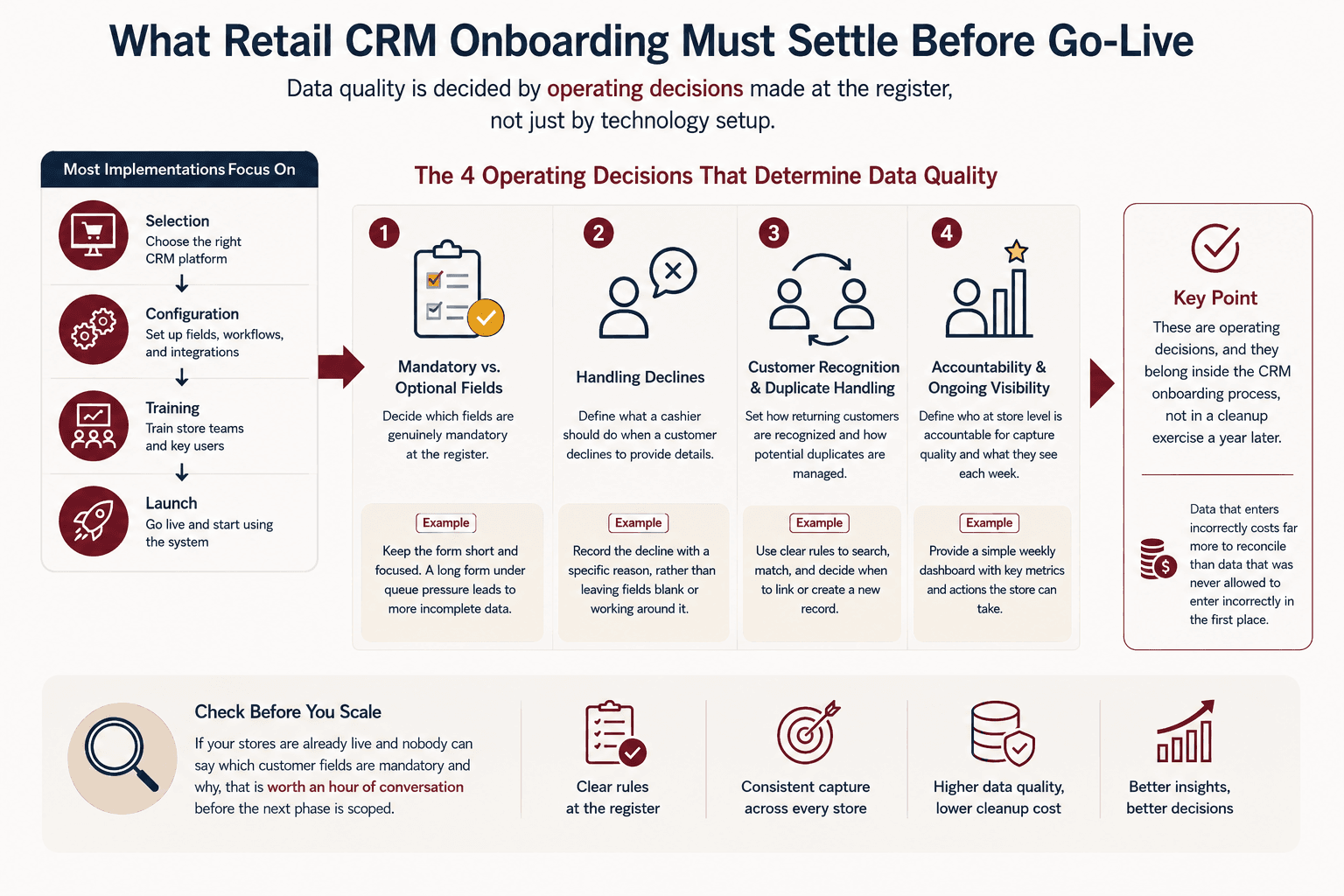
A retail CRM implementation is usually planned around selection, configuration, training, and launch. What actually determines data quality is a smaller set of operating decisions that often go unmade before the system goes live.
The first is which fields are genuinely mandatory at the register and which are not, accepting that a long form under queue pressure can produce worse data than a short one. The second is what a cashier should do when a customer declines to provide details, so that a decline is recorded rather than worked around.
The third is how a returning customer is recognized, and what happens when two records appear to describe the same person. The fourth is who at store level is accountable for capture quality, and what they are shown each week so they can act on it.
These are operating decisions, and they belong inside the CRM onboarding process, not in a cleanup exercise a year later. Data that enters incorrectly costs far more to reconcile than data that was never allowed to enter incorrectly in the first place.
If your stores are already live and nobody can say which customer fields are mandatory and why, that is worth an hour of conversation before the next phase is scoped.
Design Customer Data Capture Into the Shift, Not Into a Training Slide
Retail CRM onboarding works when the capture step is designed around the shift rather than explained in a classroom. That means a form short enough to complete without holding the queue, a defined response for every situation a cashier will actually meet, a consistent way to record a customer who prefers not to share details, and a weekly view of capture quality that the store manager owns rather than head office.
The objective is not to make store teams collect more information. It is to make the information they collect consistent, usable, and explainable, while keeping the process practical during a busy trading period.
One point is particularly important in retail: customer data collected at the register carries obligations about consent and use, and those obligations belong inside the capture rule itself rather than in a separate compliance exercise afterward. A rule a cashier can understand and follow in ten seconds is also the rule most likely to be followed correctly.
Why POS Data Capture Matters to Your CRM
The point-of-sale system is often treated as the transaction layer, while the CRM is treated as the customer layer. In practice, the two are connected by the quality of the information captured during the transaction.
If the POS creates duplicate customer records, accepts inconsistent names, or allows critical information to be entered differently from one store to another, the CRM inherits those problems. This makes POS data capture an important part of retail CRM onboarding, because the question is not simply whether the CRM can store the required information, but whether a store employee can capture that information correctly, consistently, and quickly while serving a customer.
That distinction is easy to overlook during a technology project and expensive to correct afterward. A well-configured CRM cannot compensate for an operating process that produces unreliable customer data at the register.
The Cost of Poor Retail Customer Data
Poor customer data rarely stays confined to the CRM. Duplicate records can distort customer counts, incomplete contact details can reduce the usable audience for campaigns, and inconsistent store-level capture can make one location appear to have better customer performance than another when the difference is actually in how information was recorded.
The consequences can reach customer segmentation, loyalty programs, marketing campaigns, reporting, and customer experience management. This is why data quality should be treated as an operating standard rather than a technical cleanup task.
When every store follows the same capture rules, head office can have greater confidence that differences in the data reflect differences in customer behavior rather than differences in how employees entered the information.
Where Our Work Fits
We design and document rather than advise and depart. What the group keeps is a written customer data capture standard, the decisions behind it, and a reporting view store managers can run without us in the room.
We are vendor-neutral on technology. These rules can be configured into whatever CRM platform and point-of-sale system the group already runs, and we have no reason to recommend replacing either when the gap is in the operating rules.
We also stay until it works. Our engagements run through four stages: Mobilization; Discovery, Design and Documentation; Implementation; and Optimization. The last one exists because a capture rule that has not survived a peak trading week has not been proven.
This supports the team already at the counter. Your store managers know where the queue breaks and which requests customers resist, and your CRM lead knows what the reporting needs.
What is usually missing is a documented standard that holds across every store, and someone with time to settle it outside the trading day. That is the gap we close, working alongside them.
Start Before the Next Retail CRM Phase Is Scoped
If your retail CRM onboarding is still being planned, or you have gone live and the customer data is not usable, the place to begin is the capture step at store level rather than the configuration at head office. Before adding more fields, changing the CRM, or starting another data-cleaning exercise, establish how customer information is actually being captured at the register.
The CRM Is Chosen at Head Office. The Data Is Made at the Register. The quality of the final database depends on whether the operating rules at that register are clear enough to work during a real trading day.
Syrave offers a complimentary 60-minute Discovery Call to review how customer data is captured across your stores today. No pitches, no commitments, just a direct review of what you have and honest feedback on what is missing.
Connect with Syrave – Business Operations Consulting
Email: ngan.nth@syrave.vn
Book a meeting at here: discovery conversation
LinkedIn: linkedin.com/company/syrave-consulting
Website: syrave.vn
Office: Ho Chi Minh City, Vietnam
Leave A Comment