
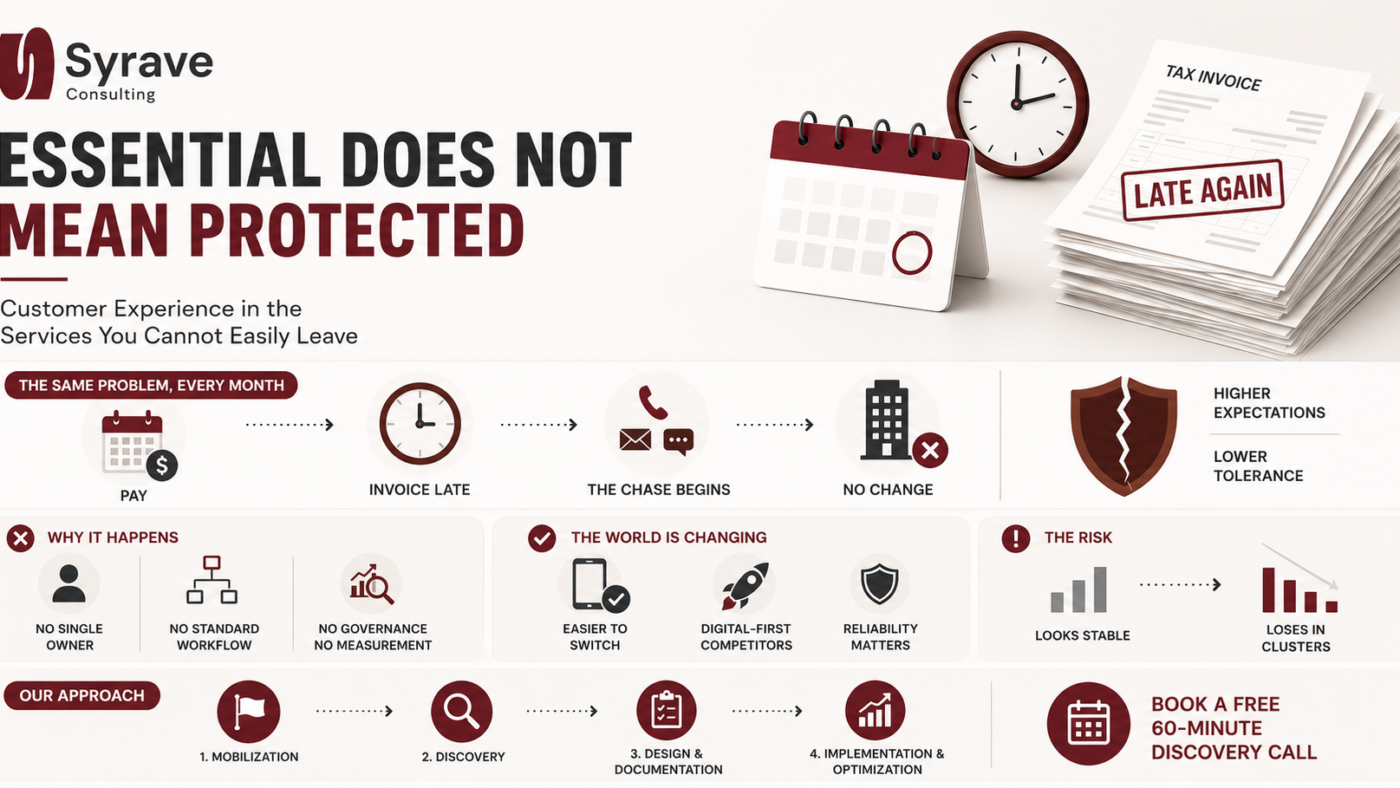
Every month, a company waits for a document it has already paid for. An essential provider charges a routine service fee and is required to issue a tax invoice at month end so the client can record the expense. The document is predictable, the amount is known, and the obligation is clear. Yet each month the invoice arrives late, and only after the client begins to chase it.
The pattern is familiar to anyone who buys from a service they cannot easily replace. The follow-up starts on the first of the month, then repeats every few days. The branch says to contact the account manager. The account manager says the request belongs to head office. The hotline says head office has no record of it. Two weeks in, the answer is the same as the first day: we will check and get back to you. It repeats, month after month, unchanged.
The problem is not one slow day. It is the absence of a system.
It is tempting to blame a single unhelpful employee or a busy period. The recurrence tells a different story. When the same predictable output fails the same way every cycle, the cause is structural, not personal. Three patterns appear again and again in essential services.
First, no single person owns the recurring task, so accountability dissolves at every handoff between branch, relationship management, and head office. Second, there is no standard workflow, so an output that should be automatic depends entirely on the customer chasing it. Third, there is no governance, so the same breakdown returns each cycle with no one measuring it or correcting the root cause.
Essential services have long been shielded by one thing: the cost of leaving. Changing a corporate banking relationship, a utility, or an insurer is disruptive, so customers absorb the friction and stay. That shield is real, but it masks operational gaps rather than solving them.
If a routine, predictable task in your operation still depends on the customer chasing it, that is a design problem worth a conversation. Book a free discovery call with Syrave to map where accountability is breaking down.
What happens next: the shield is thinning
The assumption that customers stay because they have nowhere to go is beginning to expire. Three forces are lowering the cost of leaving. Open standards and streamlined digital onboarding are making it faster to move a relationship elsewhere. New digital-first competitors treat routine outputs, such as issuing documents and processing recurring transactions, as fully automated, so “we will check and get back to you” simply does not occur. And business buyers increasingly weigh service reliability, not only price, when they choose and renew providers.
Two paths follow from this. Providers that treat customer experience as a design problem, assigning clear ownership, standardizing the workflow, and measuring it, will keep their highest-value relationships. Providers that rely on switching cost will look stable for a while, then lose customers in clusters the moment leaving becomes easy. Losing a segment all at once is far more damaging than losing one account at a time.
Technology alone will not close this gap. Automation and service bots layered onto a process that no one owns only produce a faster version of the same runaround. Systems amplify the process beneath them, whether that process is sound or broken.
How Syrave approaches it
Customer Experience Operations is the pillar built for exactly this failure. We do not deliver a slide deck and leave. We embed into your operations and work through four stages: Mobilization, Discovery, Design and Documentation, and Implementation and Optimization.
In practice, we map the recurring service moments that customers actually experience, then assign a single owner to each one so accountability no longer evaporates at a handoff. We standardize and document the workflow, with a clear service level for how and when each output is delivered, so it no longer depends on a customer following up. Then we build the governance layer that measures whether the standard is met and surfaces breakdowns before customers feel them.
This work supports the team you already have; it does not replace them. Many of these failures live in the gaps between departments, where no internal function can close the loop alone. That connective workflow, and the governance that keeps it honest, is what we design and hand over. Because we are vendor-independent, the design is built around your operation and your data, not around a platform we happen to favor.Customer loyalty is now earned in every category, including the ones customers used to feel stuck in. If you want the unglamorous, recurring moments of your service to work without a customer chasing them, book a free 60-minute discovery call. No pitch, just clarity: Discovery now!!!
Leave A Comment