
1.The Programme That Exists on Paper
Many businesses already have a loyalty programme in place. Points are issued at the point of sale, membership cards have been distributed, tiers have been named, and the programme was launched with internal announcements and a round of customer communication.
A year later, the enrolment rate is low, active redemption rates are even lower, the team rarely mentions the programme to customers, and leadership has stopped reviewing the data because the numbers have simply not moved.
The programme did not fail because it was badly promoted. It failed because it was never properly designed. There is a significant difference between a loyalty mechanic that has been launched and a loyalty system that has been designed to produce a specific outcome and most businesses have the former while very few have the latter.
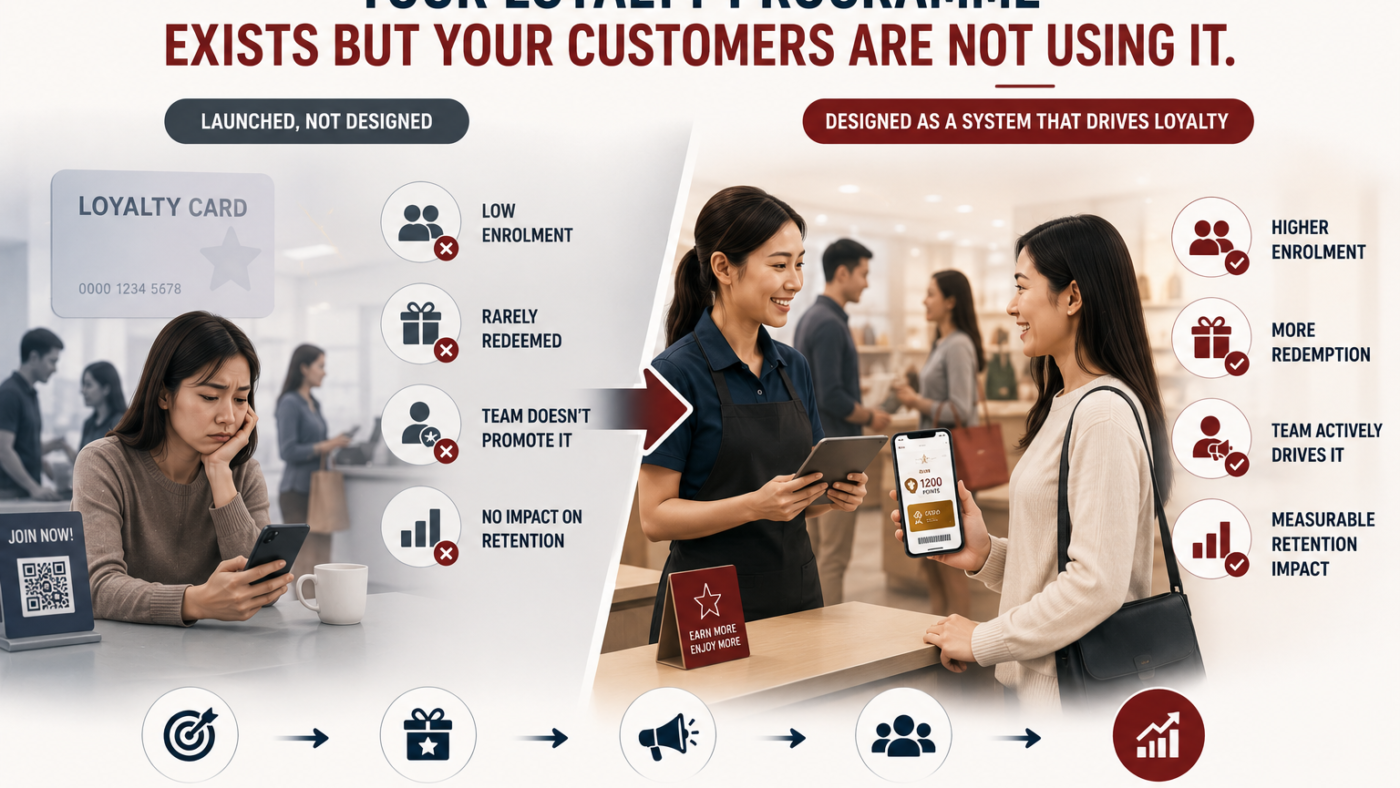
2.Four Signals That the Programme Was Launched, Not Designed
Enrolment is low and declining after the initial push: A programme that enrolled customers in its first few months but has not grown meaningfully since has a value proposition problem. Customers assessed it, decided it was not worth participating in, and moved on. The issue is not awareness, it is perceived value.
Points accumulate but are rarely redeemed: Low redemption is often misread as a positive sign, the business has issued liability it does not have to honour. In practice, low redemption signals that customers do not find the redemption options worth pursuing. A programme that does not motivate redemption does not motivate the behaviour that leads to redemption, which is repeat purchase.
The team does not mention it: If frontline staff and sales teams are not actively enrolling customers and communicating the programme’s value, the programme is effectively invisible at the most important touchpoint. This is almost always a sign that the team was never given a clear reason to drive it: no target, no incentive, no accountability.
There is no data connecting programme participation to retention outcomes: If the business cannot answer whether loyalty members retain at a higher rate than non-members, the programme has no measurable purpose. A loyalty system that cannot demonstrate its own impact on the metric it was designed to affect is a cost centre, not an operational asset.
These signals do not mean the programme should be scrapped. They mean it needs to be redesigned from its operational foundation.
If your loyalty programme is not producing measurable retention outcomes, the design needs to be examined before more resources go into promoting it. Syrave offers a focused 60-minute Discovery Call to identify exactly where the structural gaps are — no pitch, no commitment.
Booking meeting now or email mkt@syrave.vn
3.The Difference Between a Mechanic and a System
A points mechanic defines how customers earn and redeem: A loyalty system, on the other hand, defines the specific customer behaviour the mechanic is designed to produce, the operational processes that support it, and the team accountability structure that makes it function in practice.
Most businesses have designed the mechanic: Almost none have designed the system around it and the consequence is a programme that is technically operational but behaviourally inert. Customers earn points because they transact, not because the programme motivated an additional transaction. The business is rewarding behaviour that would have happened anyway, at a cost it cannot justify with outcome data.
Mechanics need to be connected to a target behaviour: A points programme that rewards every transaction equally does not differentiate between the customer who was already loyal and the customer who needed an incentive to return. The mechanic needs to be designed around the specific behaviour gap whether that is increasing visit frequency, increasing spend per visit, or preventing the lapse that occurs at a predictable point in the customer relationship.
Redemption options need to be genuinely motivating: The value of a point is determined not by its face value but by what it can be exchanged for. If redemption options do not match what the customer actually values, the programme does not produce the motivation it was designed to create. Designing the redemption architecture therefore requires a clear understanding of the customer segment not just an inventory of the product or service catalogue.
The programme needs to be visible at the right moment: Loyalty enrolment and engagement happen at specific moments in the customer interaction at the point of first purchase, at the point of a complaint resolved well, at the moment a customer is about to lapse. If the programme is communicated only through passive channels and not actively raised at these moments, the opportunity to activate it is missed consistently and at scale.
4.Why Businesses Choose Syrave
We design and document, not just advise: A Syrave engagement produces a loyalty system with documented mechanics, defined target behaviours, redemption architecture, and the operational processes that connect the programme to day-to-day team activity not a set of recommendations to improve what is already in place.
We are vendor-neutral on technology: The platform used to operate the loyalty programme is selected based on what genuinely serves the business and the customer, not based on any platform preference or commercial partnership.
We stay until it works: Enrolment rates, redemption activity, and retention outcomes are tracked through go-live and into the stabilization period, and if the design is not producing the target behaviour, adjustments are made within this engagement not deferred to a future one.
5.Redesign the System, Not Just the Promotion
If your loyalty programme is not producing measurable retention outcomes, more promotion will not fix it. The issue is structural and the fix requires redesigning the mechanics, the redemption architecture, and the operational processes that connect the programme to actual customer behaviour.
Set aside 60 minutes for a Discovery Call with Syrave. We will assess your current programme against the outcomes it was designed to produce and outline what a structural redesign would look like: no pitches, no commitments. Direct audit and honest feedback.
Connect with Syrave — Business Operations Consulting
Email: mkt@syrave.vn
Booking a meeting at here: discovery conversation
LinkedIn: linkedin.com/company/syrave-consulting
Website: syrave.vn
Office: Ho Chi Minh City, Vietnam
Source: Bond Brand Loyalty — Loyalty Report | Accenture — Customer Loyalty Research
Leave A Comment