

1. The Window That Closes Before Most Teams Respond
A prospect submits an enquiry. They have made a decision not to buy, but to be open to a conversation. That openness has a short shelf life.
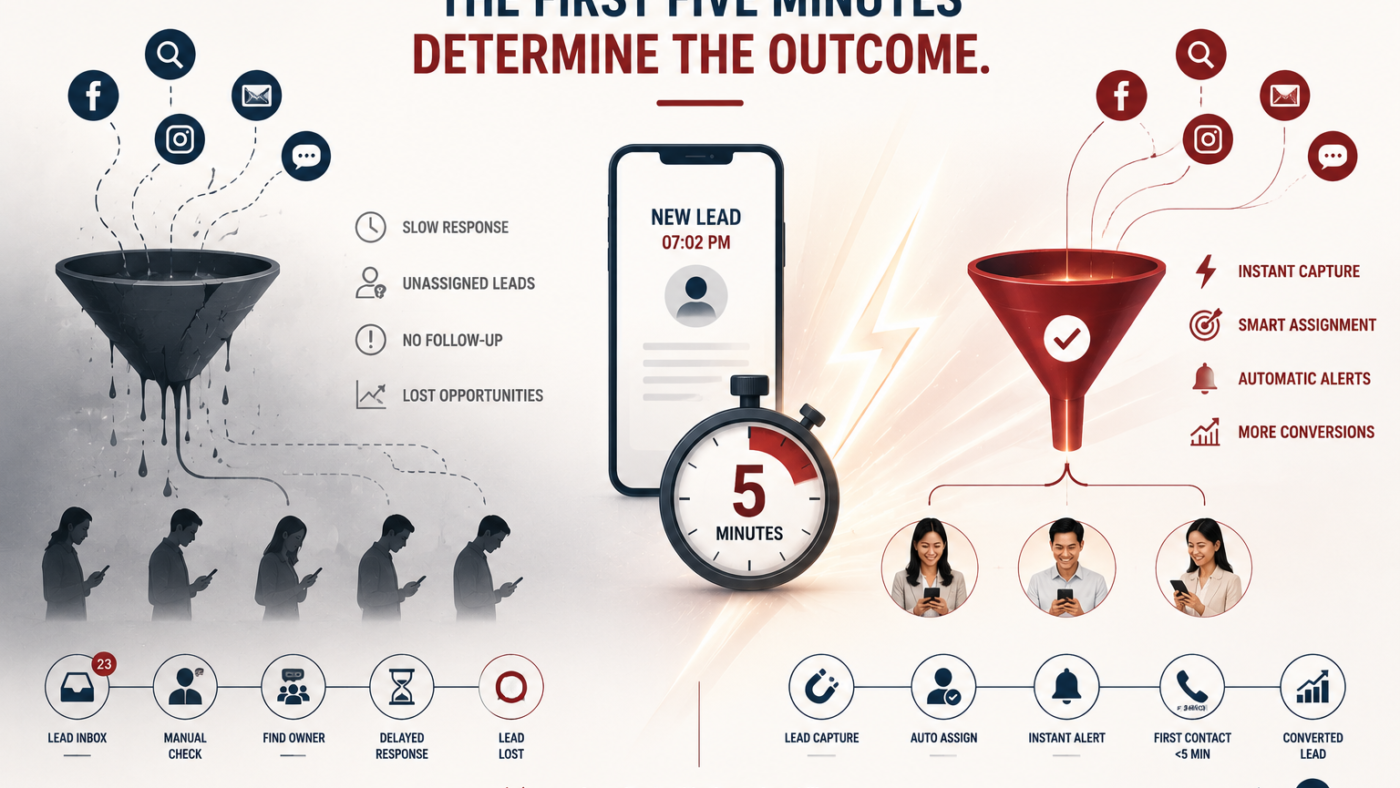
Research consistently shows that the probability of reaching a prospect drops sharply after the first few minutes. By the time most sales teams respond often measured in hours, sometimes in days the prospect has either moved to a competitor or moved on entirely. The lead is recorded as uncontacted, or worse, as a failed follow-up, when the actual failure happened in the infrastructure long before any human picked up the phone.
Speed-to-lead is not a sales discipline problem. It is an operational design problem. And it is one of the highest-leverage points in the entire lead management system.
2. Where the Delay Is Actually Coming From
Manual lead intake: When leads from paid campaigns, website forms, and messaging platforms arrive in different places: a shared inbox, a spreadsheet, a personal phone, there is no automatic trigger for action. Someone has to notice the lead, record it, and assign it. That process introduces delay before any sales activity has begun.
Unstructured assignment: When it is unclear which team member should contact a new lead, the lead waits while the question is resolved. In teams without defined routing logic, this resolution happens informally through a group chat, a question to the manager, or a default to whoever is available. Each step adds minutes that compound into hours.
No escalation when response does not happen: Without a system that tracks whether a lead has been contacted and triggers an alert when it has not, slow response is invisible until it appears in a monthly report. By then, the opportunity has been lost for weeks.
These are infrastructure gaps, not performance gaps. The team cannot respond faster than the system allows them to.
If your team is losing leads in the gap between capture and first contact, the infrastructure needs to be examined. Syrave offers a focused 60-minute Discovery Call to identify exactly where the delay is occurring: no pitch, no commitment.
Booking meeting now or email mkt@syrave.vn
3. What a System Designed for Speed Looks Like
When lead management infrastructure is designed with response speed as a primary requirement, the outcome is an operation where leads move from capture to contact without manual intervention holding up the process.
Every lead is captured centrally and immediately. Regardless of which channel a lead arrives through paid campaigns, organic search, direct messaging, or referral the lead enters a single system automatically. There is no manual transfer step between capture and assignment.
Assignment follows defined logic, not availability. The system routes each lead to the right team member based on pre-configured criteria geography, product interest, team capacity without requiring a manager to make that decision in real time. The lead arrives in the right person’s queue immediately.
Non-contact triggers an alert, not a missed entry. If a lead has not been contacted within a defined window, the system escalates. The manager is notified. The lead does not silently age in a queue while the team assumes someone else has handled it.
The result is not a faster sales team. It is a system that removes the delay that was occurring before the sales team was even involved.
4. Why Businesses Choose Syrave
We design and document, not just advise: Every system Syrave architects includes the routing logic, escalation rules, and SLA documentation that governs how leads move through the pipeline implemented and operational, not left as a recommendation.
We are vendor-neutral on technology: The platforms used to automate lead capture, routing, and alerting are selected based on operational fit and what is already in place not on platform partnerships.
We stay until it works: Syrave remains engaged through go-live and into the stabilization period. Response time metrics are tracked, and if the system is not performing as designed, adjustments are made in this engagement.
Engagements follow four stages: Mobilization, Discovery, Design and Documentation, and Implementation and Optimization with transparent milestone billing at each stage.
Syrave works across Vietnam, Singapore, and Malaysia, with cross-industry experience in Automotive, Retail, F&B, Hospitality, and Trading.
5. Stop Losing Leads Before Your Team Has a Chance to Speak to Them
If your response time is measured in hours rather than minutes, the problem is not the team it is the infrastructure they are working within. Redesigning that infrastructure is the highest-leverage change most lead management operations can make.
Set aside 60 minutes for a Discovery Call with Syrave. We will identify exactly where delay is entering your lead flow and outline what a faster, more reliable system would look like: no pitches, no commitments. Direct audit and honest feedback.
Connect with Syrave — Business Operations Consulting
Email: mkt@syrave.vn
Booking a meeting at here: discovery conversation
LinkedIn: linkedin.com/company/syrave-consulting
Website: syrave.vn
Office: Ho Chi Minh City, Vietnam
Source: Harvard Business Review — The Short Life of Online Sales Leads | InsideSales Research — Lead Response Management Study
Leave A Comment