

1.The Manager Who Cannot Manage
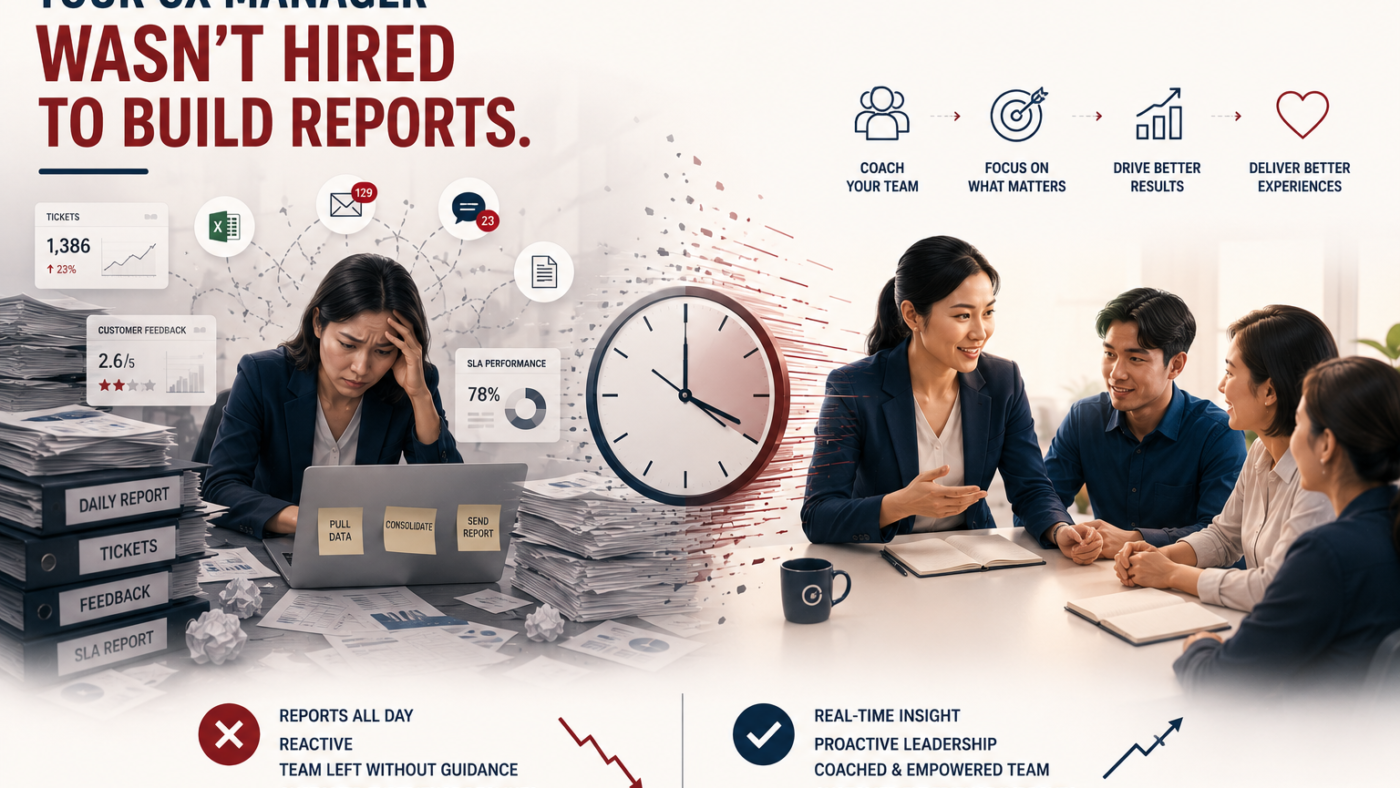
In many CX operations across regional markets, the manager is the most overloaded person in the room.
They begin each day pulling data from multiple platforms: customer feedback scores, ticket volumes, resolution times and manually assembling it into a consolidated report for leadership. By the time that report is ready, half the morning is gone.
The team goes unsupported, coaching sessions get postponed and escalations pile up. The manager becomes a reporting function rather than a leadership one.
This is not a time management problem, it is an operational design problem. The role was never properly structured for the scale it is now expected to carry.
2.What This Looks Like in Practice
Visibility without insight: Data exists across three or four platforms, but no single view gives the manager a clear picture of team performance. Every morning starts with manual consolidation before any actual decision-making can happen.
Reactive management: Because reporting takes priority, the manager is always responding to yesterday’s problems rather than preventing tomorrow’s. Service quality issues are identified after the fact, not in time to course-correct.
Team development as an afterthought: Coaching, skills development, and performance conversations are consistently deprioritized. The team operates without structured guidance, and service consistency suffers as a result.
These patterns are most visible in multi-brand retail groups, F&B chains, and automotive service operations where the volume of customer interactions is high and the expectation for consistency is constant.
If your CX manager is spending more time on data assembly than on team performance, the structure needs to change. Syrave offers a 60-minute Discovery Call to help you diagnose exactly where the bottleneck is no pitch, no commitment.
Book a meeting or email mkt@syrave.vn
3.Why Reporting Consumes Management Capacity
The root cause is rarely laziness or inefficiency. It is an infrastructure that was built for a smaller operation and never redesigned as the business grew.
When a CX team is small, manual consolidation is manageable. The manager knows every customer interaction, every team member’s performance, every open issue. As the team grows, the same manual processes remain but the volume multiplies.
The result is a management layer that is technically present but operationally consumed. Leadership receives the reports, but the team loses access to real guidance and support. Meanwhile, customers experience a service operation held together by individual effort instead of a system intentionally designed to scale.
The fix is not to hire more managers, it is to remove the structural friction that is consuming the manager’s capacity in the first place.
4.Syrave’s Approach: Designing Management Capacity Back Into the Role
Syrave approaches the CX manager role as a design problem. The goal is to restructure the operation so that the manager’s time is spent where it creates actual value coaching the team, monitoring real-time performance, and handling escalations that require judgment.
Reporting infrastructure that runs without manual assembly: When operational data flows into a single view automatically, the manager starts the day with visibility rather than spending it on data collection. The reporting function is built into the system, not assigned to a person.
Defined performance metrics that surface issues early: Rather than discovering service quality problems through customer complaints, the manager has access to leading indicators resolution time trends, satisfaction score movements, escalation frequency that allow intervention before the problem reaches the customer.
A team structure that does not require constant manager oversight to function: When roles are clearly defined and accountability is documented, the team can operate within boundaries without needing the manager to be the decision point for every issue. The manager’s involvement becomes strategic rather than operational by default.
This is not about reducing the manager’s role. It is about restoring it.
5.Why Businesses Choose Syrave
Syrave’s engagement model is built on one principle: we design and document, not just advise. Every engagement produces implementation-ready deliverables: role definitions, reporting architecture, and documented workflows not slide decks with recommendations.
We are vendor-neutral on technology. The reporting and performance management tools we recommend are selected based on operational fit, not platform preference.
We stay until it works. Syrave remains engaged through go-live and into the stabilization period. If the new structure is not performing as designed, we adjust not in a future engagement, but in this one.
Engagements are structured around transparent milestone billing across four stages: Mobilization, Discovery, Design and Documentation, and Implementation and Optimization.
Syrave works across Vietnam, Singapore, and Malaysia, with cross-industry experience in Automotive, Retail, F&B, Hospitality, and Trading.
6.Give Your CX Manager the Capacity to Actually Lead
If the person responsible for your customer experience is spending the majority of their time producing reports, the structure is working against you. Operational redesign is not a luxury it is the precondition for consistent service quality.
Set aside 60 minutes for a Discovery Call with Syrave. We will identify the specific reporting and management gaps in your current operation and outline what a structured redesign would look like: no pitches, no commitments. Direct audit. Honest feedback.
Connect with Syrave — Business Operations Consulting
Email: mkt@syrave.vn
Booking a meeting at here: discovery conversation
LinkedIn: linkedin.com/company/syrave-consulting
Website: syrave.vn
Office: Ho Chi Minh City, Vietnam
Source: McKinsey & Company — The State of Customer Care 2022 | Gartner CX Research
Leave A Comment