
1.The Tragedy of Hypergrowth
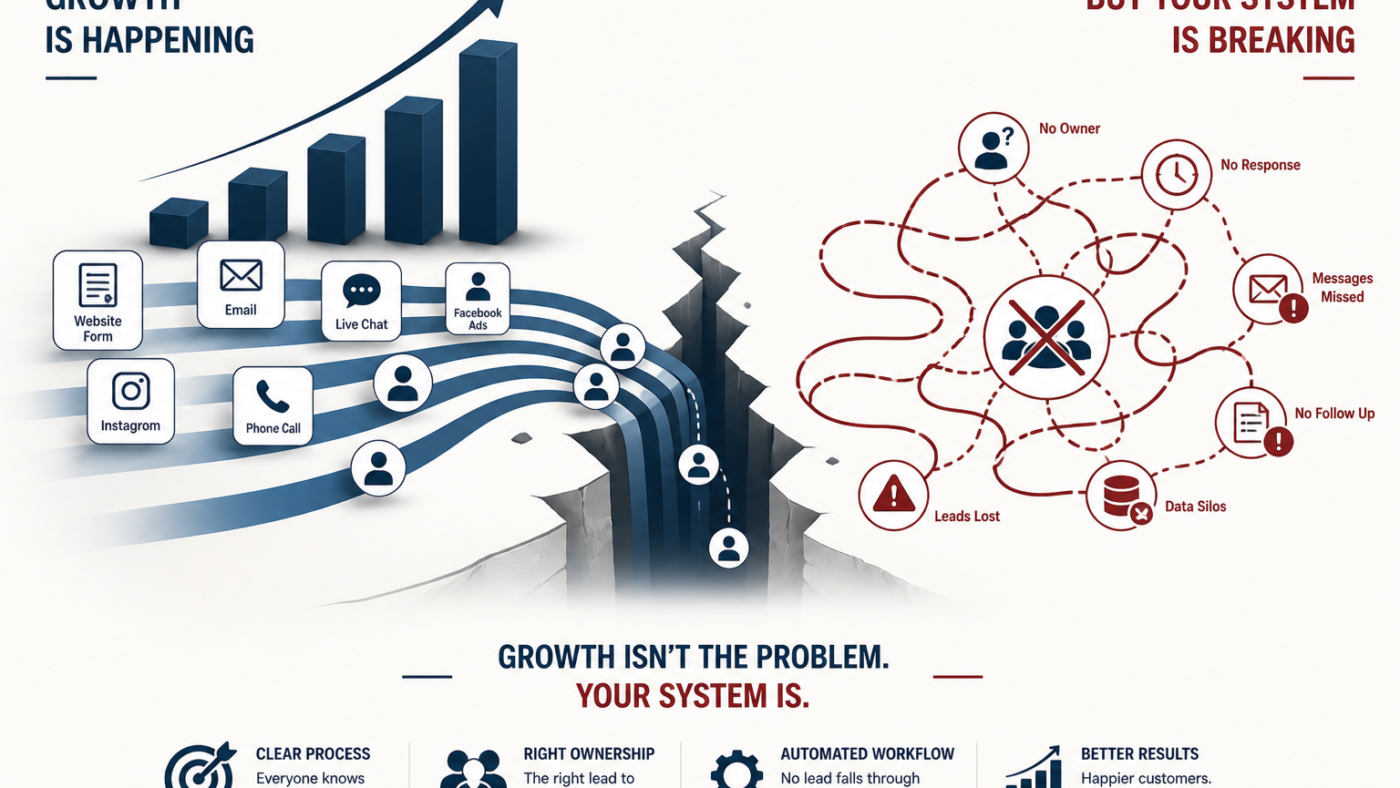
In business, the relentless push for rapid revenue growth almost always comes packaged with a dangerous trap: an operational infrastructure that simply cannot keep up.
Most businesses today run on individual hustle rather than system strength. And there’s a deadly tipping point waiting for almost all of them: the 100-employee threshold. That’s where the scrappy, flexible processes that worked beautifully at 20 people start quietly falling apart at the seams.
The problem: Marketing, Sales, and Accounting are all reporting different numbers, because nobody has a single source of truth.
The invisible complaint: A customer is venting on social media, but your frontline team has no idea it’s happening. Nothing gets resolved. The experience goes from bad to worse.
Managers are burning 80% of their time putting out small operational fires instead of thinking about where the business is actually going.
The gap between revenue growth and operational maturity isn’t just a technical inconvenience — it’s a strategic risk. When your marketing campaigns pour in hundreds of leads but your sales team has no standardized process to handle them, you’re hemorrhaging money through a hole nobody’s talking about. Hidden lead attrition isn’t a sales problem. It’s a systems problem.
2.Who Syrave Actually Is
We position ourselves explicitly as Systems Architects – practitioners who embed into a client’s actual operations to design the infrastructure, build the governance documentation, and stay until the system genuinely works in the real world.
Our work is organized around four core strategic products, designed to touches a customer, all the way through to lifelong loyalty:
2.1. CX Operations Standardization
Restructuring customer-facing teams by clarifying roles, building SOPs, defining multi-level KPI frameworks, and automating away the repetitive manual tasks that drain your team’s bandwidth and attention.
Most companies assume growth problems start with a lack of leads.
In reality, the breakdown usually happens after the lead has already arrived.
Delayed responses, inconsistent communication, and unclear ownership quietly erode customer trust.
By the time conversion rates begin to drop, the damage has already been done.
Customer experience is not a soft function. It is an operational system that must be designed, measured, and managed with the same rigor as sales or marketing.
Syrave treats CX as a structured discipline, not a vague service philosophy.
Their approach focuses on three critical layers.
Every customer interaction has a clearly defined owner – from first response to final resolution, responsibility is never ambiguous.
Teams operate on consistent SOPs for handling inquiries, complaints, and follow-ups.
No customer is left unattended, and no step depends on individual improvisation.
Multi-level KPIs track response time, resolution quality, and customer satisfaction.
Leadership gains a clear and reliable view of actual service performance.
When CX is built as a system rather than handled reactively, conversion rates improve without increasing marketing spend.
Because growth is not just about generating attention.
It is about what happens after a customer decides to trust you.
2.2 Lead Management System Design Mapping
The complete customer journey from the first touchpoint to signed contract. Every lead stage is controlled by automated triggers, and leadership gets a dashboard they can actually trust — in real time.
In the competitive landscape, the cost to acquire a single qualified lead is climbing fast. In industries like automotive or real estate, one lead can cost anywhere from tens to hundreds of dollars. Yet without a professional lead lifecycle system in place, companies are quietly throwing tens of thousands of dollars out the window every single month.
Syrave designs Lead Lifecycle Management systems built on three strict principles:
Automatic lead routing. The moment a customer fills out a form on your website or messages you on Facebook, the system immediately assigns them to the right salesperson — based on geography, product line, or historical closing performance. No delays. No manual handoffs.
Status rules. Every lead must live inside a clearly defined status — New, Contacted, Qualified, Test Drive Scheduled, and so on. Employees can’t quietly let leads go cold, because the system automatically flags any lead without interaction after 4–8 business hours.
Nurturing automation. For warm-but-not-ready-to-buy prospects, automated SMS, messaging apps, and email sequences deliver value-adding content on a schedule — keeping the brand present in the customer’s mind until they’re ready to make a decision.
When these systems are properly designed and enforced, the impact is measurable.
Clients have seen up to 30–50% improvement in lead conversion rates after fixing their operational systems.
In many cases, businesses generate a high volume of leads each month but struggle to convert them due to unstructured or inconsistent handling processes.
After restructuring their lead management systems:
• Lead routing is automated based on relevant criteria
• Follow-up rules are clearly defined with response time expectations
• Pipeline stages are standardized across the organization
Within 90 days:
• Lead response time decreases significantly
• Follow-up consistency improves across teams
• Conversion rates increase meaningfully (≈ 30–50% improvement)
No additional marketing budget is required.
The improvement comes from fixing how leads are handled after they enter the system.
2.3 CRM Architecture Consulting Designing
The data structure and automation logic before anyone even opens the software configuration panel. The goal: a CRM that serves your process — not one that forces your people to contort their workflows around it.
a mistake we see repeatedly : a company buys an expensive CRM, expecting the software to automatically fix their operational problems. Six months later, the platform has become another administrative burden and half the team has quietly stopped using it.
The software is just the shell. Without the right data architecture and process logic behind it, even the best CRM in the world becomes dead weight or worse, a system people work around.
Syrave’s CRM consulting starts by answering the questions that actually matter, before a single license is purchased:
How should customer data be structured so it’s genuinely useful for analysis down the road?
What automation logic will reduce manual data entry and free up the team’s time?
How does this CRM integrate with the existing ERP, call center system, and advertising platforms?
The result is a CRM that’s custom-fitted to the way the business actually runs — where every feature has a clear purpose, and salespeople spend more time selling than they do filling out reports.
2.4 Customer Loyalty Architecture Design Building
Points systems, membership tiers, and cross-sell triggers for multi-brand conglomerates — so customers stay engaged across an entire ecosystem, not just a single transaction with a single brand.
Competing on short-term discounts is a losing game. The real competitive advantage is ecosystem – loyalty keeping customers meaningfully engaged across multiple brands, business lines, and decades of relationship.
For a multi-vertical group operating across several consumer industries, a customer who completes one purchase should not be the end of a transaction. It should be the beginning of a long-term relationship that flows across every business line in the portfolio
Syrave helps these organizations build that ecosystem around three core components:
Cross-brand points. A customer who completes a major purchase in one business line earns points redeemable across other services in the group. Value flows across the ecosystem.
Group membership tiers. A VIP member in one premium business line automatically receives matching privileges across other premium services in the group. Status travels with the customer.
Cross-sell triggers. When a customer’s service contract is approaching expiration, the system automatically generates a tailored renewal offer from the group’s relevant business unit — timed perfectly and delivered personally
One element Syrave pays particular attention to: the incentive structure for frontline staff. If a sales consultant doesn’t personally benefit from referring a customer to another brand within the group, no loyalty program in the world will generate real cross-brand behavior. The system has to reward the people who make it work — or it stays an idea on paper.
If any of this sounds familiar, it’s not a people problem – it’s a system design problem.
Syrave works with businesses to identify exactly where their CX, Lead Management, and CRM architecture are breaking down and rebuild them into systems that actually scale.
Set aside 45–60 minutes for a structured discovery conversation.
3.The People Behind Syrave
The difference with Syrave starts at the top, with a founder who has genuinely sat on both sides of the table.
With over a decade of hands on operational and advisory experience across major conglomerates, Syrave’s CEO brings a rare dual perspective:
Enterprise technology deployment experience at scale — supporting thousands of businesses across multiple regions, maintaining adoption rates consistently above 80%.
Executive-level CRM and customer relations experience with major multi-brand conglomerates — supporting the standardization of dealer/retail networks and architecting complex loyalty ecosystems for organizations at scale
That background understanding both the technical language of system builders and the business language of executives who need results — is genuinely rare in this market. Syrave’s clients aren’t managed by junior account managers working off a template. They work directly with someone who has faced their exact pressures and solved their exact problems.
4.The Time to Act Is Now
A solid operational infrastructure is the passport that lets Vietnamese businesses compete with confidence in today’s global environment. Waiting until the system collapses under the weight of growth before attempting to fix it is an expensive way to learn that lesson and it’s almost always harder to rebuild than to build right the first time.
Operational transformation is a journey that demands commitment and patience. But the returns it delivers in both financial performance and team stability are difficult to overstate.
If your business feels like it’s running on an overloaded operating machine , Syrave offers a 45–60 minute discovery conversation. Not a sales pitch. Just a genuine, structured conversation to identify exactly which bottleneck is holding back your next breakthrough.
We don’t come to pitch – we come to listen.
Connect with Syrave — Business Operations Consulting
Email: mkt@syrave.vn
Booking a meeting at here: discovery conversation
LinkedIn: https://www.linkedin.com/company/syrave-consulting/
Website: syrave.vn
Office: Ho Chi Minh City, Vietnam
Leave A Comment