


A customer returns an item at the service desk. There is no receipt, the purchase was a few days outside the stated window, and the item has clearly been used. The written procedure covers returns with a receipt, inside the window, in original condition. It says nothing about this. The associate makes a decision, and it is a reasonable one.
The same situation arrives at another store the following week and is decided the other way, also reasonably. Neither associate did anything wrong. What neither had was a retail SOP that acknowledged the case exists. Retail SOP work is mostly about the cases the original document declined to address.
Why Retail SOPs Stop at the Normal Case
Procedures are usually written by describing the process as it is supposed to run. Someone walks the standard transaction from start to finish and records the steps. That produces an accurate document and a useful one for training, and it is the right place to begin.
The difficulty is that the standard transaction rarely needs a document. Staff learn it in their first week and perform it hundreds of times. What they cannot resolve from memory is the case that falls outside it, and that is precisely the material most retail standard operating procedures leave out, because at the time of writing it felt like an edge case rather than part of the job.
In a store, those cases are not rare. Receipts are lost, items arrive damaged, a promotion is misread, a shelf price does not match the till, and a customer escalates in front of a queue. Across a week, the exceptions are a meaningful share of what the service desk handles, and they are the interactions that generate complaints, write-offs, and inconsistency between stores.
Because they are undefined, they are resolved by whoever is standing there, usually under pressure. The outcome depends on that person’s confidence rather than on an agreed position. Head office sees it only in aggregate, as refund variance between stores or as a complaint that reached the group inbox.
What Retail SOP Work Has to Settle
Writing more pages does not help. Four questions do.
The first is which exceptions actually recur, which is an evidence question rather than an imaginative one, answered by looking at what the service desk handled last quarter rather than by listing everything that could theoretically happen. The second is who decides at each level, so an associate knows what is theirs to resolve and what belongs to the duty manager.
The third is where discretion ends, expressed as a boundary the associate can apply without calling anyone. The fourth is how the decision gets recorded, because an exception that is resolved and never logged teaches the organization nothing, and the same case will be argued again next month.
If two of your stores would answer the same return differently today, that is worth an hour of conversation.
Writing the Exception Into the Procedure
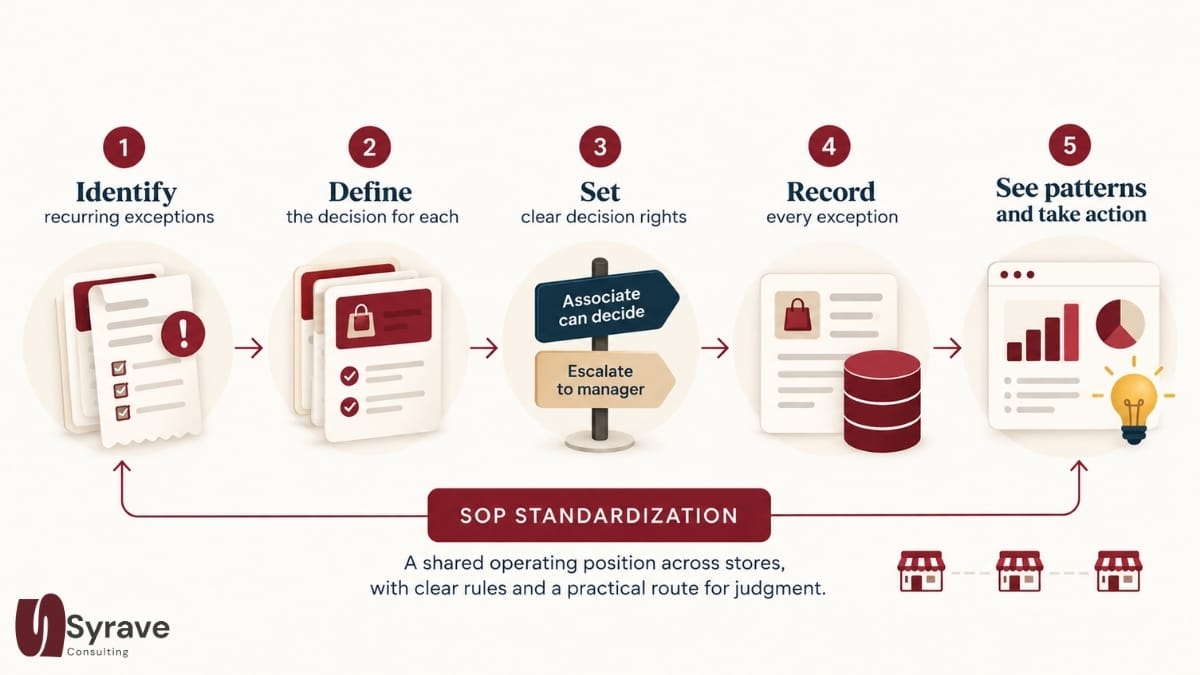
A retail SOP that handles exceptions well does not try to enumerate every case. It names the handful that recur, states the decision for each, sets the boundary of what an associate may settle alone, and gives one route for everything outside that boundary. The associate’s task becomes recognizing which situation they are in, rather than inventing a position under pressure.
The recording step matters more than it appears to. When exceptions are logged in a consistent form, the pattern becomes visible, and the business can see that one promotion generates most of the disputes or that one category drives most of the returns without receipts. At that point, the exception stops being a service desk problem and becomes information the group can act on.
This is where SOP standardization becomes more than documentation. The objective is not to create a larger manual. It is to create a shared operating position that different stores can apply consistently, while still giving managers a clear route for cases that genuinely require judgment.
Where Our Retail SOP Work Fits
We design and document, rather than advise and depart. What the group keeps is a procedure set that names its own exceptions, decision rights by role, and a recording format the stores can run without us in the room.
We are vendor-neutral on technology. The recording can sit in whatever till system, ticketing tool, or shared log the group already uses, and we have no reason to recommend new software when the gap is in the decision rules.
We also stay until it works. Our engagements run through four stages: Mobilization, Discovery, Design and Documentation, then Implementation and Optimization. The last one exists because a decision rule that has not been applied during a trading peak has not been proven.
This supports the people already absorbing these situations. Your store managers can list the arguments they have had this month, and your service desk staff know exactly which cases they dread. What they rarely have is an agreed position written down, the authority to apply it, and someone outside the trading day to settle it with them. That is the gap we close, working alongside them.
Start With Last Month’s Exceptions
Ask one store manager to list every situation in the last month that the written procedure did not cover. The list is usually short, repetitive, and much the same across stores, which is the useful part.
Syrave offers a complimentary 60-minute Discovery Call to review how your stores handle the cases your procedures do not describe. No pitches, no commitments. A direct audit of what you have and honest feedback on what is missing.
Connect with Syrave – Business Operations Consulting
Email: ngan.nth@syrave.vn
Book a meeting at here: discovery conversation
LinkedIn: linkedin.com/company/syrave-consulting
Website: syrave.com
Office: Ho Chi Minh City, Vietnam
Leave A Comment